
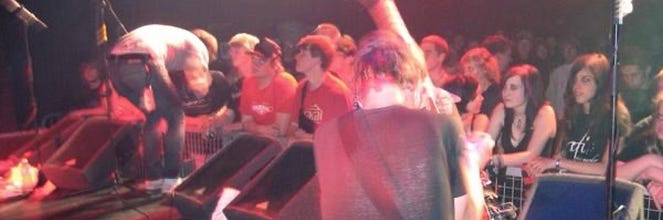
My initial intent with this Substack was to write about two main things: (1) What I consider to be “perfect punk albums,” used as part personal memoir, part music criticism, and part my own philosophy of music. And (2) my own exploration into jazz, and where I see resonance with the punk music and scene I grew up with. I’d been thinking about this series for a while, and finally pulled the trigger about a month ago.
However, over the past four months, life, or more precisely life and death, has come at me fast. And lately I’ve been sitting, and thinking, and feeling a lot about what I can only call the healing power of music. Two things have happened in these past four months that struck me so deeply that, to be honest, I didn’t even realize there was a place that deep.
So, I’m taking a pause to share those two things here.
The first is that on March 28, my brother Matt unexpectedly died.
Matt was two and a half years older than me. Over our 40-plus years of life together, we had a deeply close and loving relationship, and also a complicated and even turbulent one. Like brothers do, but also in our own particular way. It’s something I was still working through, in my own way, right up until his death. There was a lot of pain and hurt in it. There was also a profound love that you only know as a brother and, at times, as a best friend.
It’s not an exaggeration to say that music defined our lives, and certainly our life together.
I grew up listening to and playing music with him. I remember as young kids, maybe six and eight, sitting in the back seat of our parents’ car listening to our dad’s Doobie Brothers cassettes, imploring him to drive faster and turn the music up! I remember Matt dubbing me Mötley Crüe and Def Leppard tapes and using his drawing talent to copy the album art onto the covers. I remember us listening to Tone Lōc and Young MC on repeat and spitting out the rhymes together. And I remember how proud he seemed of me when I “discovered” Faith No More on my own at nine years old.
That love of music turned into making it pretty fast. When he was around 10, in the late ‘80s, he started playing drums. Our dad had an old Gretsch kit up in the attic from his own days playing. My parents, sick of Matt beating on me, sent him up there to beat on the drums instead. And he did. And he kept at it.
About five years later, after growing up listening to him constantly play along to Led Zeppelin, and then Helmet and Rage Against the Machine, and then punk, I’d fallen deep into music myself and picked up a guitar. We took lessons at the same music shop in town. We’d practice and jam together, sometimes with our dad on keyboard for renditions of “House of the Rising Sun,” which feels like we played a hundred times.
Around then, Matt joined his first band, Swivel. They practiced in our basement, so I was home for basically all their practices. I saw and heard, up close, what it was like to start and be in a band, from the technical aspects to the friendship aspects. For some reason, they never seemed to get annoyed by me. They ended up recording their demo in our basement too, and I was around for that, getting to see the whole process, and making friends with Nick Rotundo, who engineered it, along the way. Their first show, which was in a basement, was also the first punk show I ever went to: my brother’s band, in somebody’s basement, and that was the door. I somehow even got into a bar in Wilmington where they played alongside local bands Lean and Nine.
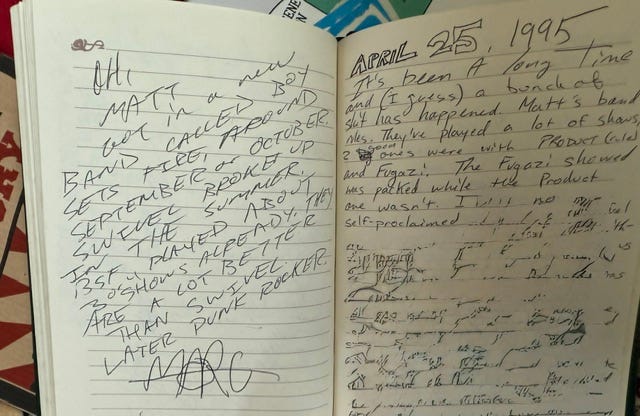
Incidentally, Swivel, Lean, and Nine broke up shortly afterward, and some of their members, including my brother, went on to form Boy Sets Fire. They also formed and practiced in our basement. I still have a photo of my journal entry around the time that happened. Here it is:
From there, our music lives ran alongside each other for years. I started bands, Network 34, Eldritch Anisette, Dorian Gray, and joined DC-based Midvale, playing with BSF dozens of times throughout. Eventually, I ended up touring Europe with BSF in nearly every capacity, first as a guitar tech, then with my own band Dear Tonight, then as a drum tech, and then joining the band itself, on bass, going on tour, writing new songs, and recording. We saw more bands together than I can remember. Some of my best memories are standing arm in arm with him, on the side of the stage at some festival, watching and singing along to Social Distortion, the Bouncing Souls, Foo Fighters, and many others. For a long stretch throughout my 20s and early 30s, my brother and I were in the same bus, the same venue, in the same band, doing the thing we’d been doing in the basement since we were kids.
Before the recent reunion shows of Eldritch Anisette, the last show I ever played was with Matt. It was the Area 4 festival in Germany in 2012. There were over 70,000 people in the audience. It was the last show of the tour. I remember Matt and I were locked in that day. I remember jumping off his drum riser countless times, and I can still hear the blast of his kick drum.
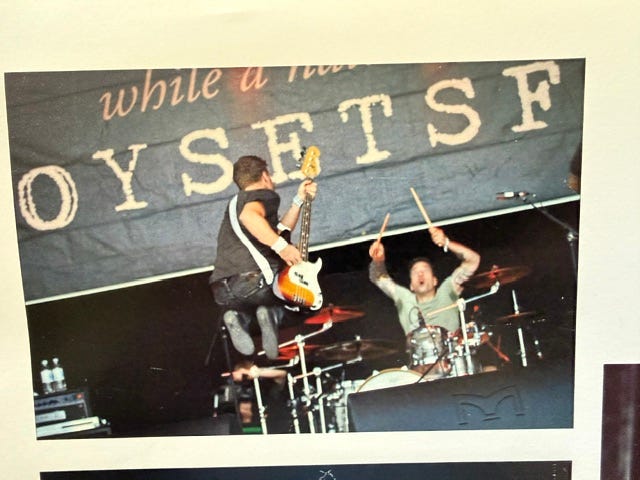
Not long after, Matt quit the band, or was kicked out, depending on who’s telling it. And I was told to choose: him or the band. There was nothing I loved more than getting out there, each day, and playing music to hundreds and thousands of strangers. Playing this thing you helped create and seeing and feeling their reaction to it, and from that, building a connection together. But BSF was never my band. It was his band. So, I chose him. I quit.
I’d do it again. But it didn’t fix anything. Our relationship got hurt in the process too, and I walked away from the whole thing. I didn’t just leave the band. I left music. I couldn’t go to shows. I couldn’t pick up a guitar. I didn’t want anything near me that reminded me of it, because all of it reminded me of loss.
That lasted years. What finally broke it was my daughter. She was about three, and she pointed at one of my guitars and asked what it was. So I took it down and played for her. And she responded immediately, bouncing along. That was the first time in a very long time.
I didn’t play with a band again until 14 years after that last BSF show, when Eldritch Anisette got back together, almost thirty years after we’d last played. Which brings me to the second thing that struck me, although in a completely opposite direction.
On the day this past March when my parents called to tell me Matt had been moved to the ICU, I hung up the phone and picked up my bass guitar.
This was not a conscious decision. I didn’t think I should play something. My hands just went, and my p-bass was the closest instrument to me. And I played the same thing over and over, for a long time, and at some point I noticed that what I was playing had become a song.
So I recorded it and sent it to Allen and Courtney from Eldritch. I didn’t tell them anything about it. No context, no explanation of what had happened or when I’d written it.
Some time later, they wrote back. They’d each written parts. And the parts fit exactly, the emotion and the tenor of it, like they’d been in the room. Without a word from me, they knew what the song was about. When I finally told them what had happened and when I’d written it, they said they’d already understood.
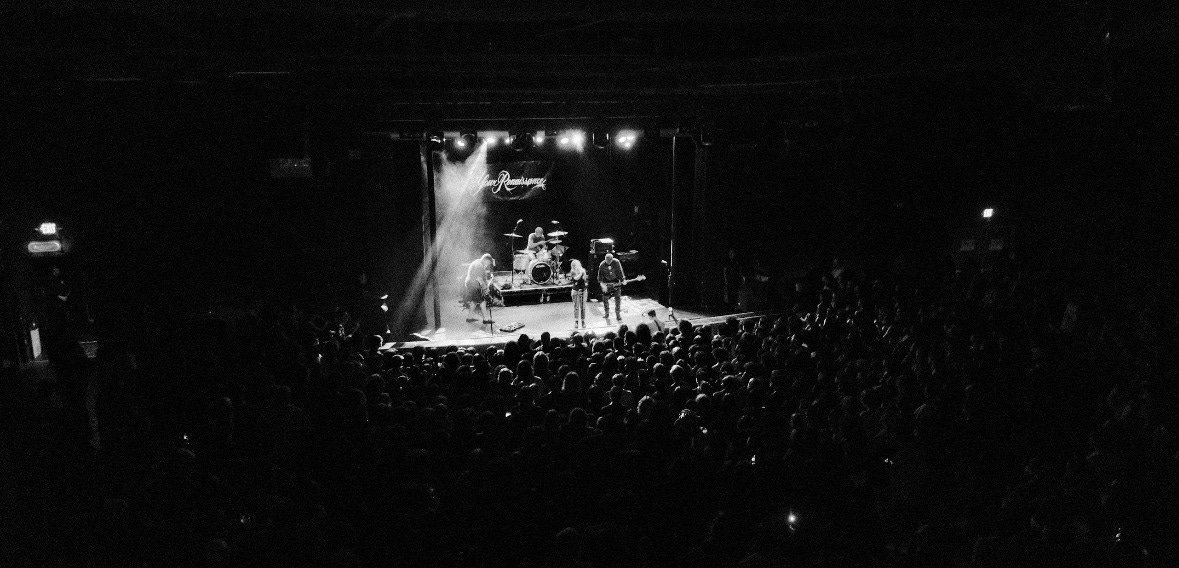
The three of us and JD worked on it and made it a real song. And we played it live at our two reunion shows this past June, the first shows Eldritch Anisette had played in 29 years, and the first shows I played since sharing a stage with my brother.
Before we played it, I had to say something.
I talked about Matt. I talked about him recently, unexpectedly dying. About how we grew up playing music together, and how he was the reason I picked up the guitar. I said that the last time I stood on a stage and played live, it was with him. I talked about how I wrote the basis for the song after getting that call from my parents, and how Courtney and Allen could just tell what it was about. I talked about how it made me truly appreciate how music is a vessel, something that can hold our emotions, something we can express into and then hand to other people. That it isn’t only self-expression, it’s collective experience, and unity. How this song would never have been fully written, and we would never be standing on that stage if it weren’t for all the people in the audience who gave us the support and courage to reunite and do so. I talked about how music holds whatever you put in it: grief, joy, anger, frustration, love, all of it. That we can express our own feelings and connect to somebody else’s at the same time. And that the music can change shape as other people touch it, in ways you don’t expect and couldn’t do alone.
Then I thanked everybody, and each of the people in the band. And then I said, I love you, Matt.
And then we tried to start the song, but I was gone.
I don’t have a better word for it. I was just gone. It felt like being back on the podium at his funeral. I tried to remind myself how the song went, but couldn’t. I came in off-time. I tried again and couldn’t find it. I couldn’t remember how the song went. I couldn’t remember what time it was in. I had written this thing myself, out of the worst day of my life, and standing there in front of 1,400 people, I could not play it.
The knowledge that over a thousand people were looking at me came through clearly. So, I said out loud, I’m sorry, my emotions were getting the better of me.
And then something so unexpected and beautiful happened.
The crowd started clapping. In unison, all of them, giving me a count. And cheering. And I could hear people calling out that they loved me. A room full of people, almost all of them under 25, none of them born the last time this band played a show, holding a stranger up.
Then JD dropped in on the hi-hat, I could focus on it, and I had it. I found my footing and we played the song.
It took me a month to move past the initial embarrassment and be able to look back at this directly.
Here’s what I saw. I just stood there and told the crowd that music is a vessel, that it holds whatever you put into it, and that once you release it, it becomes collective. And then I fell apart, but the room caught me and handed it back to me. What I was trying to describe just happened to me in front of everyone.
There’s another layer too. When Eldritch Anisette was playing the first time around in the mid-‘90s, we’d end up on bills with tough-guy hardcore bands, and we got mocked for being too “emo.” Too much feeling. Not enough breakdowns. Not tough enough. A girl singer. And here was a new generation, nearly thirty years on, and their answer to a someone losing it on stage was to support them through it. In many ways, it felt like a do-over. And, what’s more, it felt like healing. Not just for the band, but for what we were trying to do, and for what I had been going through.
And it was the drummer who counted me back in. The last time I stood in a stage was with my brother, and he was the drummer.
Several people came up to me after the show to tell me about their own losses. That’s not nothing. It’s the whole thing, actually. The vulnerability wasn’t a weakness up there, it was the door. Standing in front of strangers and being unable to hold it together turned out to be the thing that let them in.
I don’t really have a conclusion for this. And, I guess that grief doesn’t have one either. I’m still in it, still finding my way through, and there are days it’s very heavy.
Now, however, I do have gratitude. For all these things: a venue full of kids who didn’t know me and clapped anyway, a band who understood my song without explanation, for music to carry what I struggle to hold, and for a brother who got sent to the attic to beat on his drums and never stopped.
Such a beautiful heartfelt description of a transcendent life experience. And it all came full circle as life seems to do.
Sure wish there was a recording of the music you played that night.
Magical, powerful and moving. Thank you for sharing these experiences and the thread that runs through them. I’m inspired and reminded of the power of creating and collectively experiencing music. Peace to you, much love to Matt.