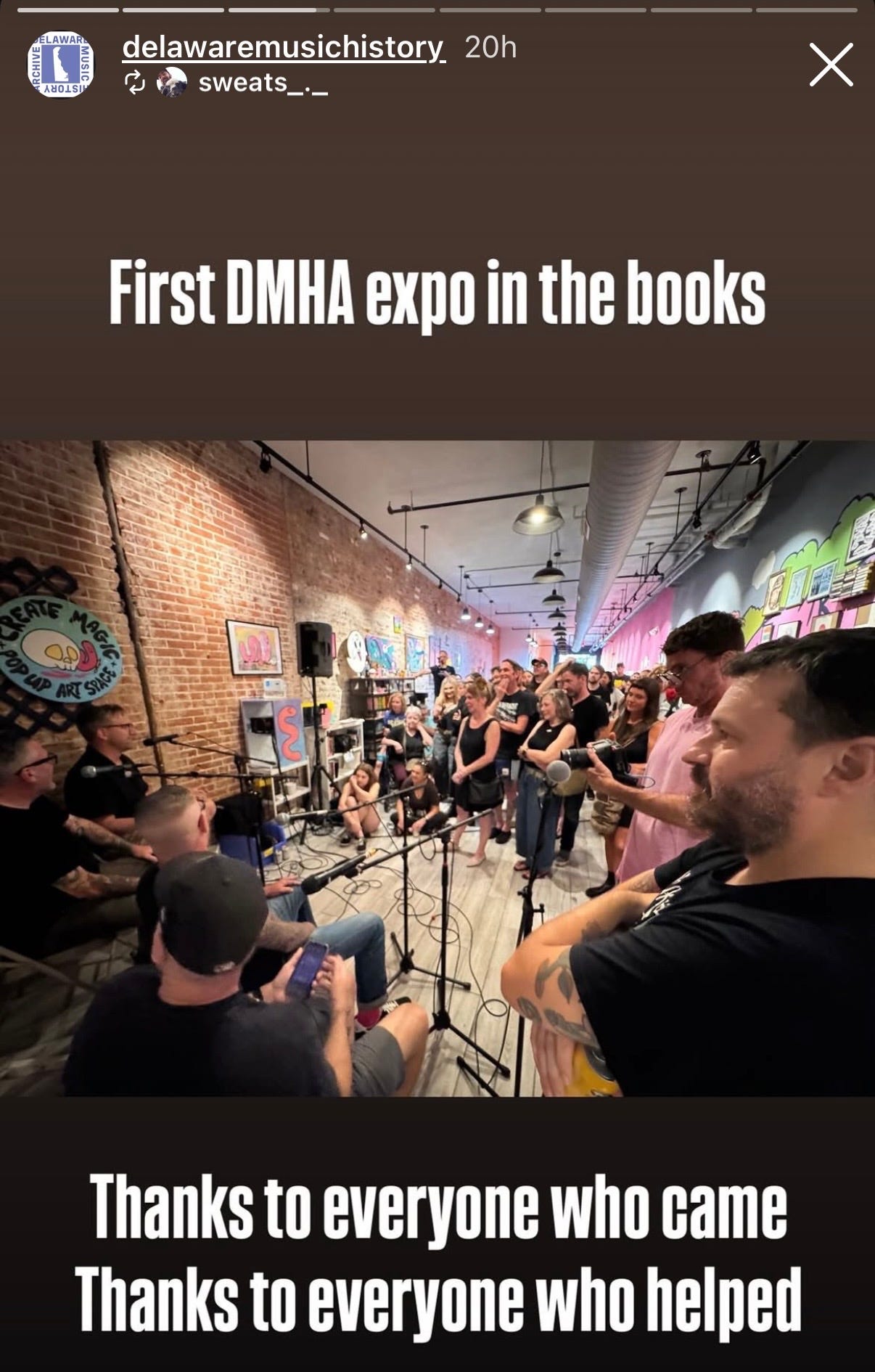
This past weekend, I drove down to Delaware for a celebration.
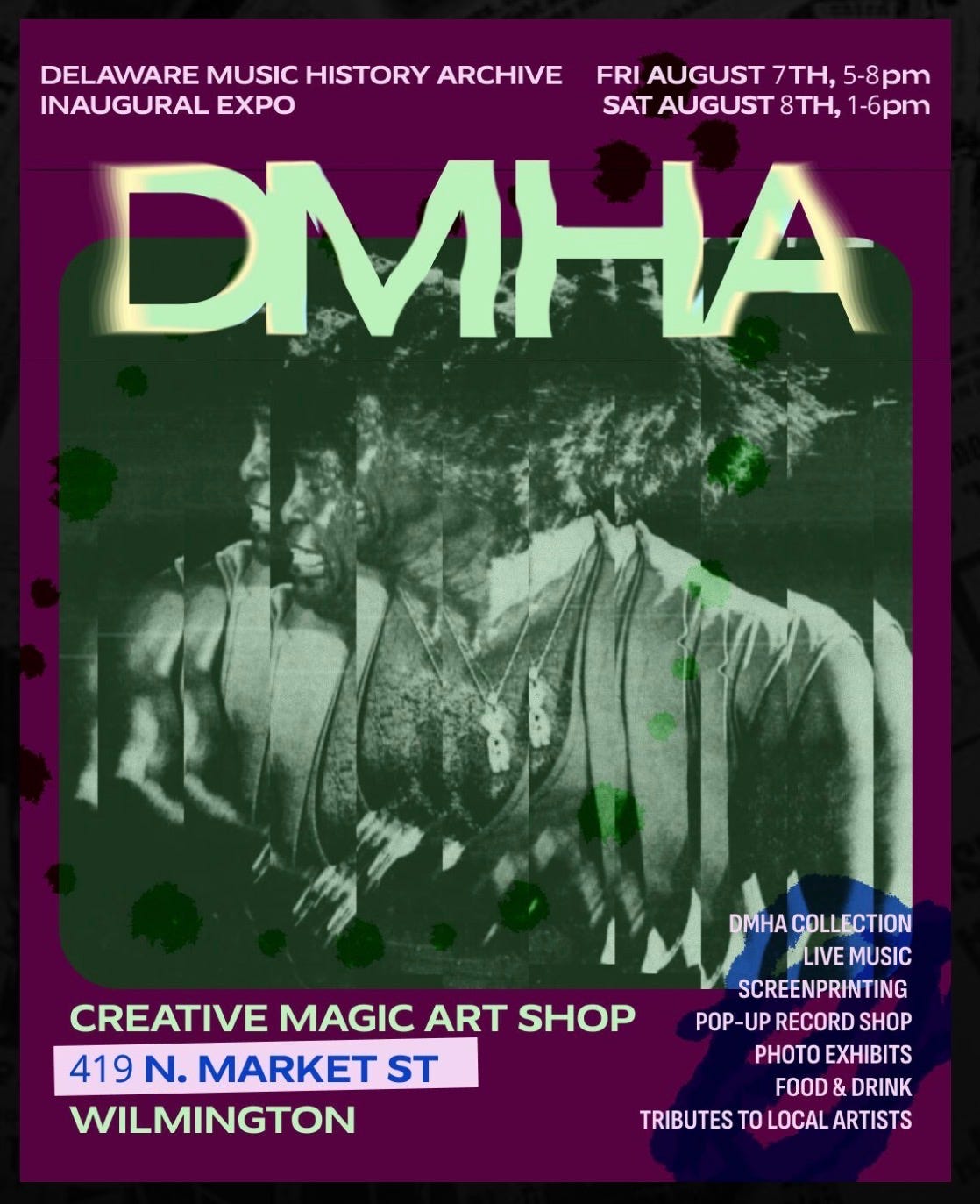
It was the first expo of the Delaware Music History Archive, a long-incubated effort recently incorporated as a nonprofit, launched by two of my friends, Chris and Paul. All weekend, the Archive had special exhibits and events to mark the span of musical incarnations across the first state. Saturday was given over to three panel presentations before a show kicked off. I was fortunate to be asked to join the third panel, along with friends Rob Avery, Chad Istvan, and Shane Evans, to speak to the lives of two of Delaware’s music cornerstones: my brother Matt and Nick Rotundo.
I’ve talked about my brother here before (drummer, de facto band manager, architect). For those who don’t know, Nick was also fundamental to the Delaware scene. Drummer and guitarist in bands like Railhed, Walleye, Kill Quota, None More Black. He was also the sound engineer in Delaware, where he launched Clay Creek Studios. He recorded everyone, including most of my bands. I talk about Nick in the write-up on Eldritch Anisette for Numero Group’s Sequoia Boxset, saying, “without Nick, there would be no punk scene.”
I went down thinking a lot about this panel, what I would say, what it would be like, who would be there, and how to share enough in a short amount of time. I went down with a narrow thinking of what the expo would be one thing, but later realized it was much more.
I saw people I hadn’t seen in years standing next to people I’d seen earlier that same day. I saw my old best friend and former bandmate, Tim, in person for the first time in years. I saw Dre, the younger sister of my other best friend at the time, who not just came out to the shows but documented this period through her camera. The BSF crew. The Delaware-to-Brooklyn crew. So many more. All of us a couple decades older, but still with the same wide smiles. It was almost like no time had passed. An instant familiarity.
At one point, my friend Daryl Hyde pointed out that four generations of BoySetsFire bass players were in the same room. Daryl, Rob Avery, me, Chris Rakus. Four people who had held down the same low end in the same band across all those years, standing around together like it was nothing.
I didn’t think anything about that at the time other than agree that we needed a photo (we did get one). But it stayed with me for the rest of the day. I’ll come back to it.
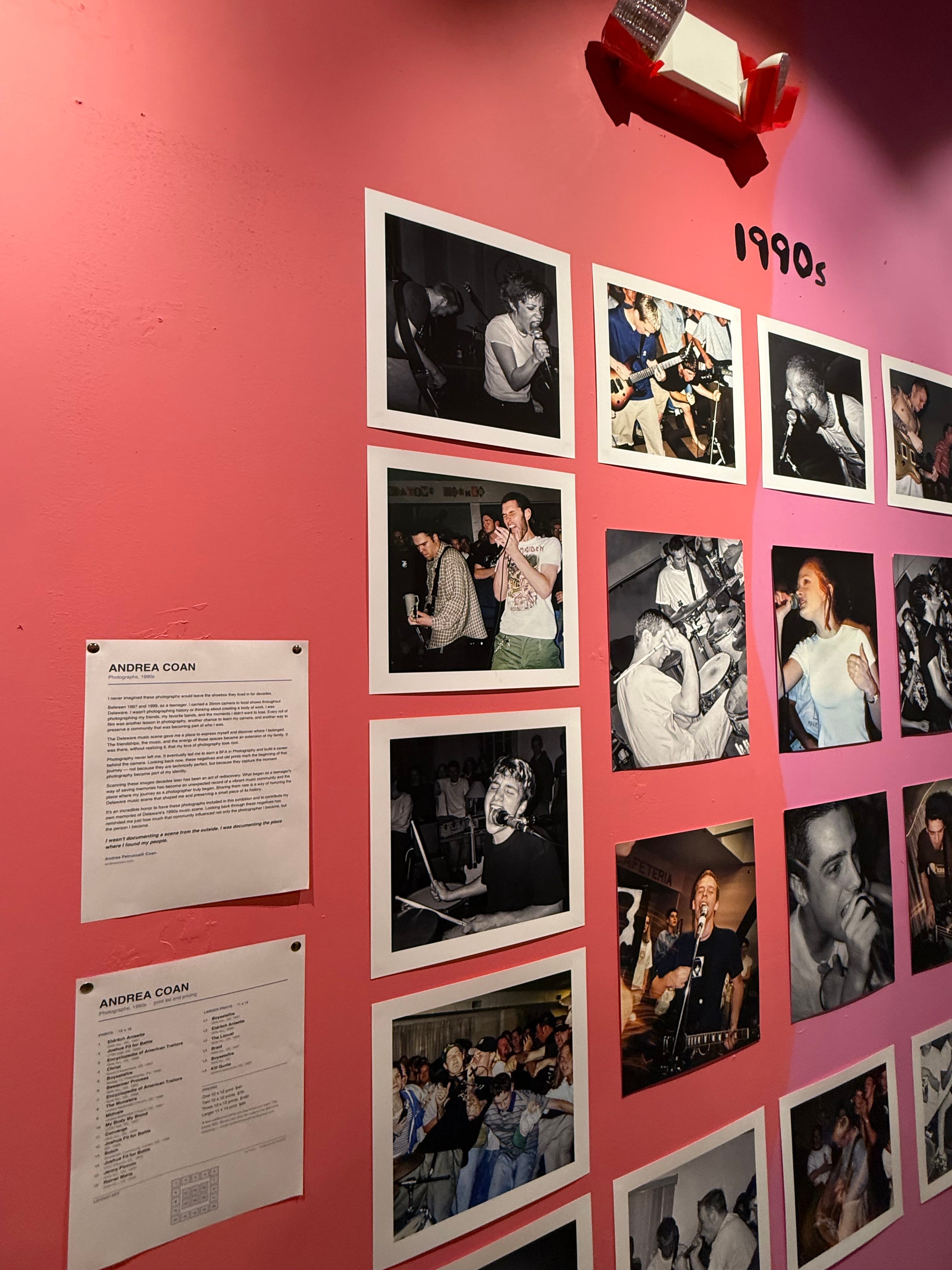
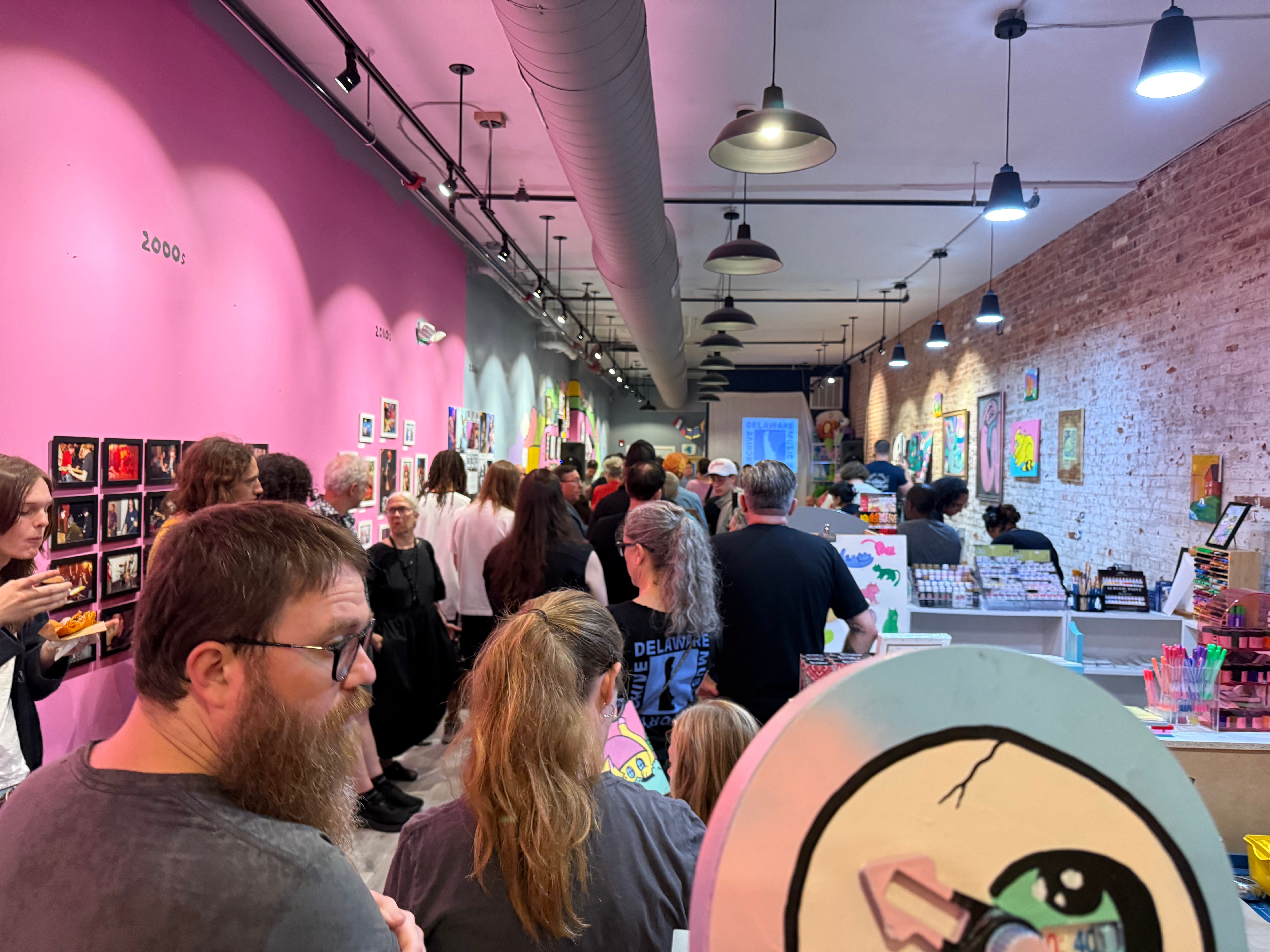
One of the things I was most drawn to was an exhibit by women music photographers from Delaware, with work spanning from the 1970s through the 2020s. Six decades of shows, shot from the front of the stage to the back of the room.
The ‘90s wall was my friend Dre’s work, and I found myself in it more than once. Three of the bands I played in were up there: Eldritch Anisette, Midvale, and The Monsters, which was Eldritch Anisette’s possessed alter ego. In the Monsters photo, I’m behind Tim’s drums, screaming into the microphone.
My parents were at the expo. Early on, they came and grabbed me, a little bewildered, and said there was a photo of someone who looked just like me on the drums, but I never played the drums. They were surprised to learn that I did.
We laughed about it. It was a funny and small revelation about how much of our musical lives had gone on without their noticing. And it brought the whole spirit of that time back to me, the spontaneity of it, the zaniness. How Allen, Tim, and I would mess around at Eldritch Anisette practices. I’d hop on the drums, Tim would grab the bass, and we’d invent alter egos and sing goofy songs about monsters coming to eat people, all over a soundtrack of blast beats and sludgecore. And then somehow we decided it made perfect sense to do that at actual shows. And it did. That was The Monsters.
Someone standing near my parents put it together and said, “Of course, you all drummed.” My dad was a drummer. Matt was a drummer. And, surprise, apparently so was I. What got to me most was that Dre had hung my photo right next to one of Matt behind his kit. The two of us on drums, side by side on the wall, which didn’t happen all that much in life.
And it wasn’t only us. Whole nights came back into focus off that wall. Braid playing at Girls Inc., Jenny Piccolo in Tim’s basement, the Locust stunning everyone on one of their first tours, and lots of Delaware bands, Bessemer Process, Kill Quota, BoySetsFire, Joshua Fit for Battle. Faces of my friends.
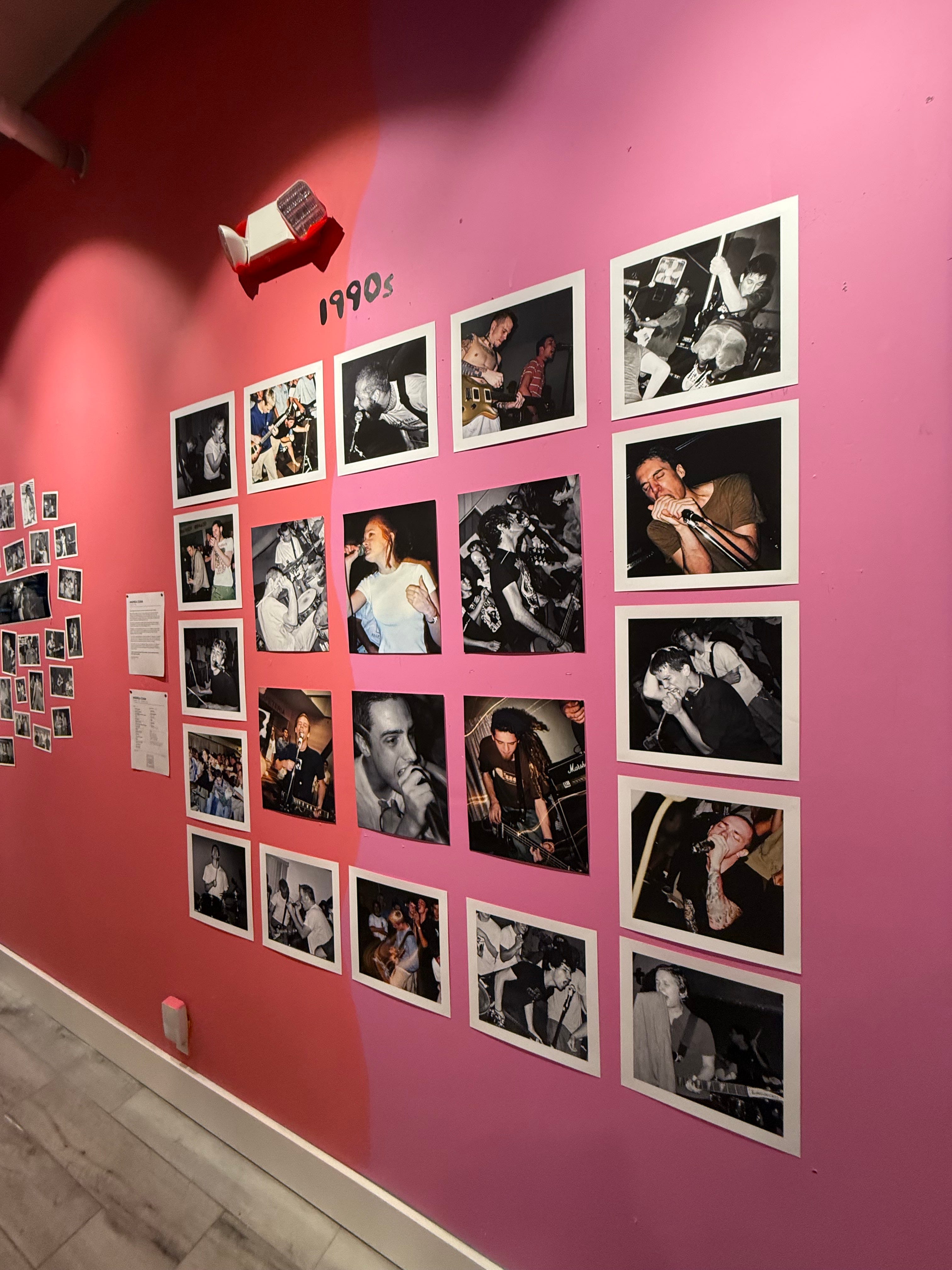
What struck me was that Dre shot these as a young teenager; she was (and still is!) younger than me, and she caught it all so clearly. The energy, the dynamism, the emotion, the noise of those rooms. And it was like that down the whole exhibit, one decade to the next, the work of the women who shot them. They weren’t only observing and documenting. They were making it. They were creating the images, the look, the meaning, the legacy of this music across all those years, as much as anyone up on a stage was.
Standing in front of those decades, something shifted for me. My time in that scene, the ‘90s, felt so rich and full and vibrant when I was inside it. It was everything. And here it was, just one section. One column of photos on a wall of them, with decades of other people’s everythings tacked to the left and right.
It reminded me of the spiral “Cosmic Pathway” at the American Museum of Natural History in Manhattan. That place is my therapy grounds, and there’s a walkway there that winds down through the history of the universe, each step standing in for hundreds of thousands of years. You walk the big bang, and then the formation of the elements, and stars, and galaxies, and planets, and you keep walking, and all of that happens before you ever get to Earth. Then you finally get to Earth, and there’s a whole history there too, stretching not just millions but billions of years. And at the very end, the entire span of human beings is the width of a single hair. It puts your time, your place, your problems, yourself in perspective.
It felt something like that. Without the immense expanse of time, of course. But something like that.
There is a possibility that one could remain sitting in that smallness. I find a quieting calmness, like a weighted blanket or a sensory-deprivation tank (yes, I’ve gone to those), in the humbling shock of our own limited perspective and existence. And while there is understanding and peace that offers me, it’s also not the full story. Because even though our own time is less than a hair-width in the existence of the universe, to each of us, it is also everything. It is all we know, and putting aside reincarnation, in this world, it’s all we have. It is both relatively minuscule and all-encompassing. So, I couldn’t and can’t just sit in the smallness.
In fact, standing in front of those decades actually sharpened two things, which led to a different realization.
The first is being present. As I noted at the top of this post, I went down principally to participate in a panel discussion on the lives of my brother and Nick. Two people whose lives ended too soon and who lived it loud while they had it. I was nervous when the panel began. Nervous to be on the stage with Shane, Rob, and Chad, three people I’ve looked up to since I was 13. Nervous to talk in front of all these people, any one of whom could also be on the stage. Nervous to talk about Matt in front of my parents in a public setting. Nervous about doing justice. As the panel started, I could feel the emotion swell. I, of course, remembered the Eldritch Anisette show in California and what happened then. But as I heard Rob, then Chad, then Shane talk, something changed in me. It went from a sadness to a joy. A joy about these two people, the humor they brought, the stories they shared, the experiences we had together. The way they livened up rooms, vans, stages, recording studios. I found two stories about Nick that Matt had written to himself on his phone, and I shared those with the room. The grief is still there, but more so, it felt like a gift to have had the chance to know them both so closely, and to see all the people in the room together, holding this space together, touched by Matt and Nick. Sitting there, the width-of-a-hair feeling didn’t read as sad. It read as an instruction. You get that hair. Live it loud.
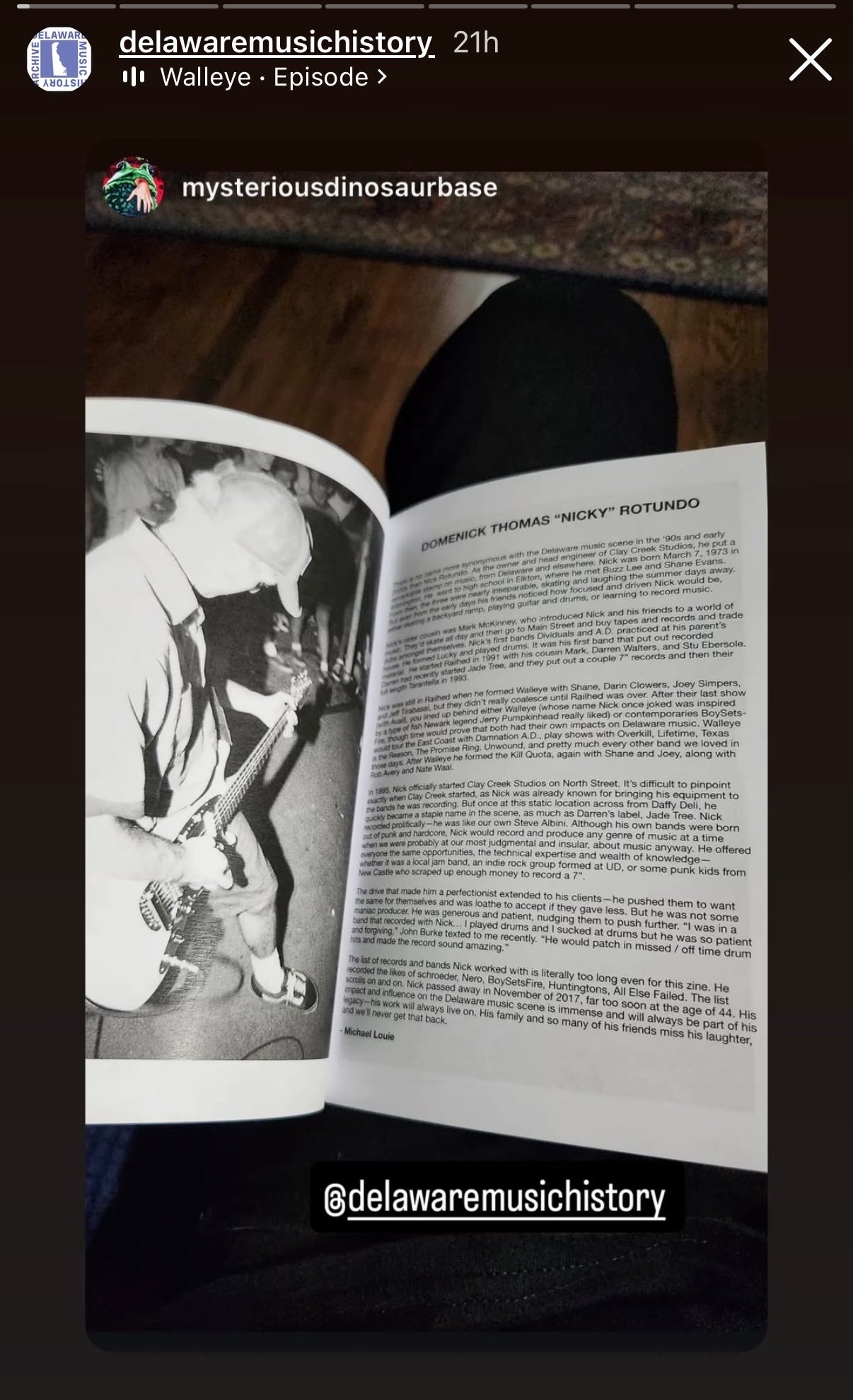
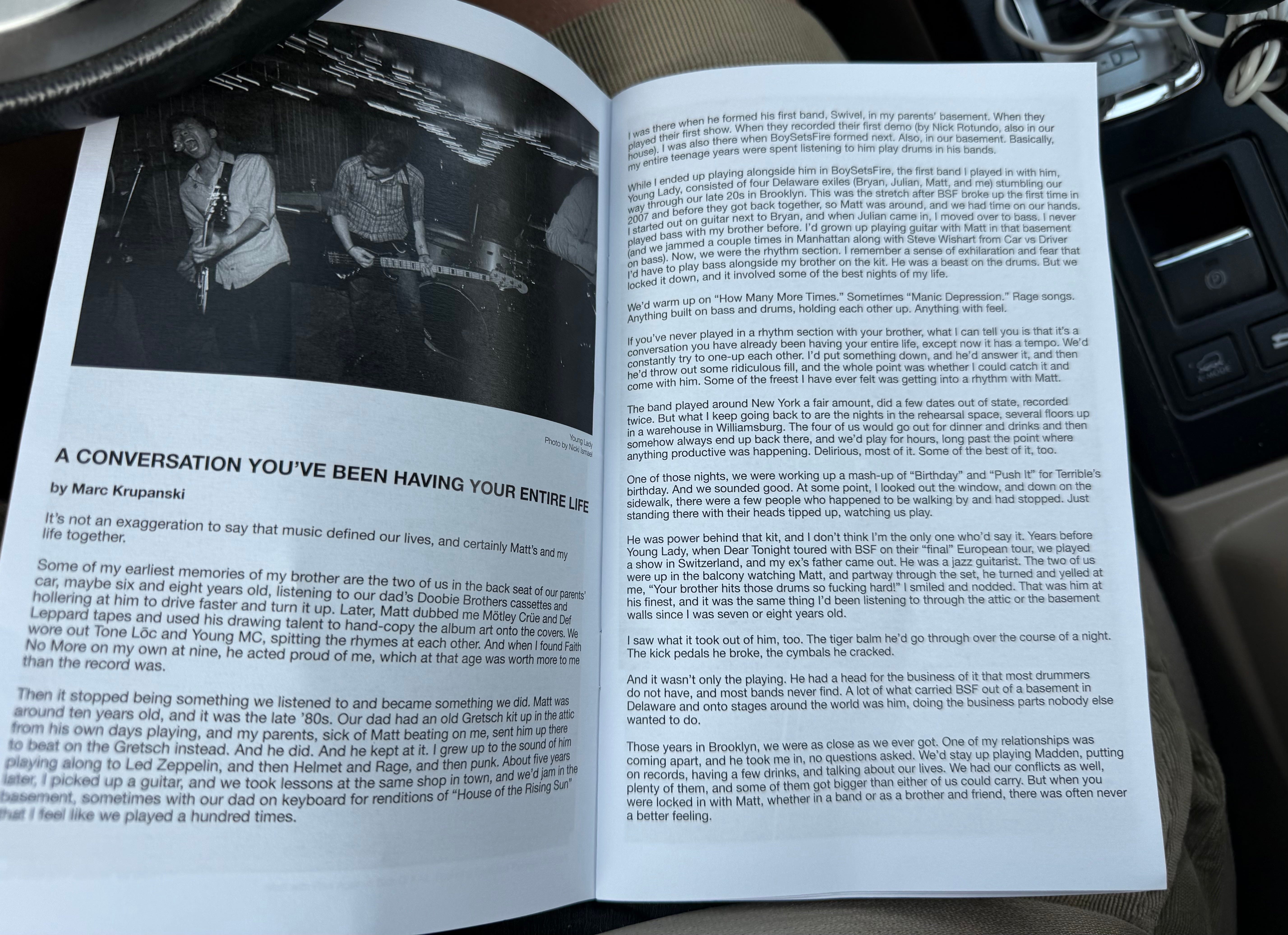
The second is the worth of the documentation itself. The archive. That someone kept the flyer. That someone took the photo and labeled it. That someone saved the tape. The zine that my friends Mike and Bryan Louie made as a tribute to Nick and Matt, and the memories written by our friends. None of it remembers itself.
Which brings me to the thing the whole night kept circling and what all this synthesized for me.
What is an archive without the people?
It is a room of objects. It needs the people, and not only the ones who wrote the songs and played them, though of course, them too. It needs the show promoters. The DJs. The visual artists who made the flyers and the album covers. The photographers, six decades of them. The record labels put out bands based on love not units moved. The audiences who showed up and moved. The parents who gave up their basements. Jason Lechmanik talking about the early days of Enoch Collective, Grouchy Greg talking about creating one of the first hip hop magazines, Mike Haley and the Electric Human Project. The sound engineers, like Nick, sitting at the board making four people sound like more than four people. The friends.
Because that panel wasn’t only celebrating Matt as a drummer and de facto manager, or Nick as a musician and sound engineer. It was celebrating them as friends. That’s what a community is for, too. It’s there while you build the thing, and it’s there after, to remember the people who built it with you.
So, back to those four bass players in one room. Daryl, Rob, me, Chris. The player keeps changing, and the low end keeps going, the rhythm keeps driving, because the thing that lasts was never any one of us. It was the whole room that made the music possible and then made sure it got remembered.
That’s what makes music special. It’s what makes it last. It’s what gives it meaning. It’s what makes it worth remembering.
It’s the community.
Thank you Delaware Music History Archive for bringing all this together.