

So, I wanted to push myself to make my first explicit post on exploring the connections between jazz and punk. I’ll keep going with my “perfect punk album” series (you can find the first three here: Spirit Assembly, SDRE, and Lungfish), but this is the stuff I’m still working my way through. This post will outline a bit of what I want to do, but I want to start with where it all began for me, the sound. And in particular, the sound of John Coltrane.
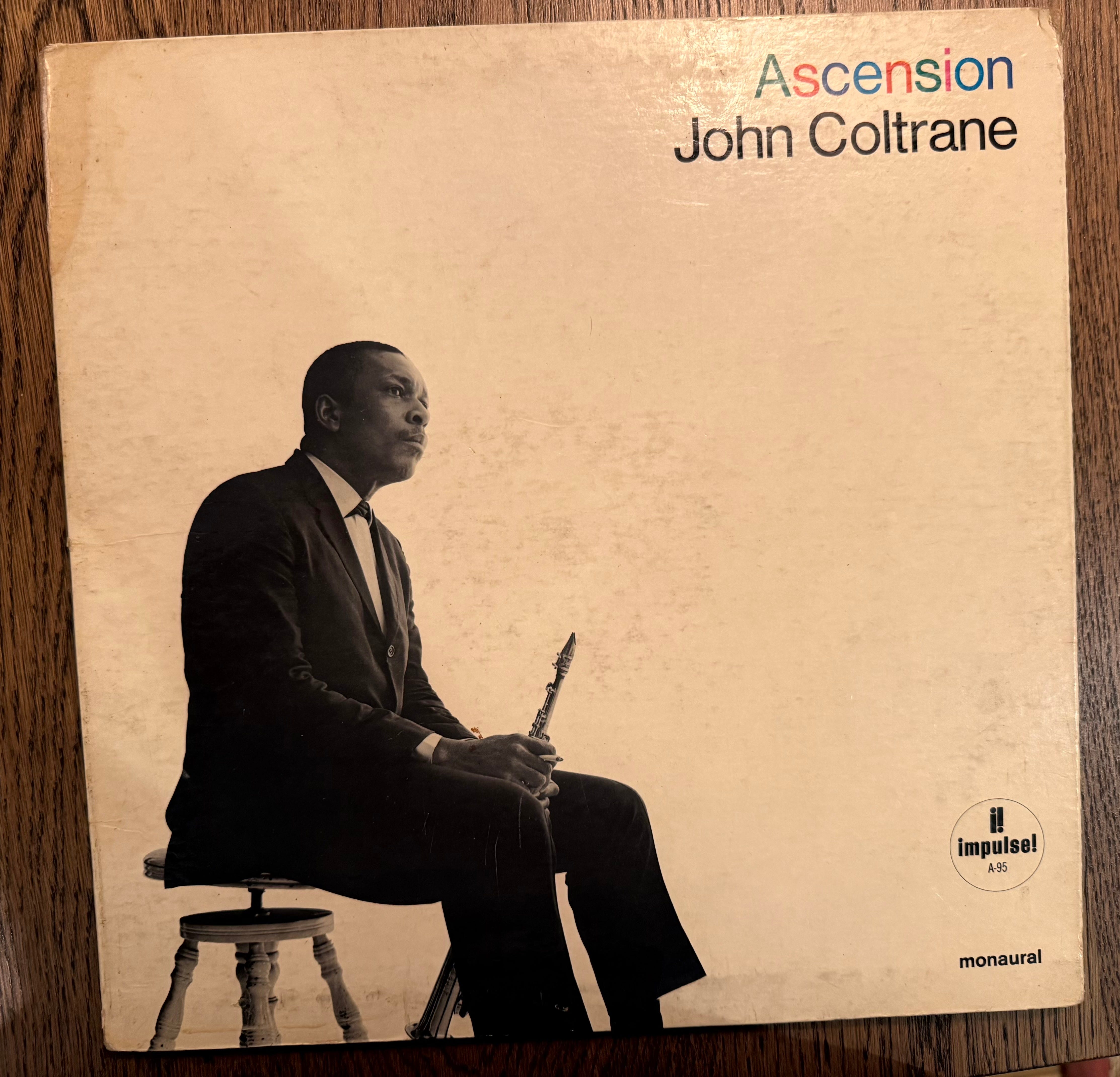
The first time I heard John Coltrane’s Ascension, I had no idea what I was listening to. To be honest, I’m still trying to understand it. I should’ve realized this from the opening of A.B. Spellman’s liner notes, “Be advised that this record cannot be loved or understood in one sitting.”
This was about twenty years ago, when I was living in Brooklyn. My friend Sean lived in the same building and was selling some of his long-held records. That’s a familiar rite of passage for many in the punk scene. The need for rent money, clearing space, taste changes, or some combination of all three drives people to open up their crates to friends. Sean’s was a little different, though. I don’t remember why he was selling them, and I don’t even remember if any punk records were actually included, even though he also came up through punk, including a stint at Maximum Rocknroll. Instead, they included original pressings of classics. Dylan. Springsteen. Stuff I didn’t expect to find in the crates of a guy who worked at MRR.
And, Coltrane’s Ascension.
That one jumped out at me, and I remember Sean telling me that I would love it and that it gets weird.
I already knew Coltrane. Or I thought I did. That came from Tim, my best friend growing up, and one of the best drummers I’ve ever known. A prodigy. We would spend hours every day listening to punk, the whole gamut: from Mohinder to Tortoise to Born Against to Rachel’s (yes, we grouped all this into punk).
But it wasn’t just punk we listened to. At 15, we’d go to jazz clubs, and he would sit in and stun all the old timers, until it reached a point where I remember they’d eagerly call him to the stage. Then we’d head back to his basement and just play, spontaneously, mostly loud and chaotic music until songs got unearthed. That’s how Network 34 was launched and several projects after. I’m pretty sure he’s the one who introduced me to Coltrane when I was around 14. We would dig in together. Giant Steps first. Then My Favorite Things. Maybe a little A Love Supreme, though not enough of it. Mostly the early stuff. Bebop and modal, well before Coltrane really went far out. Still, when he was using heroin, anecdotes about which we would trade back and forth from whatever story we heard.
(I also remember somewhere in this period, the San Diego band Swing Kids formed. We loved them. And Tim shared that he spoke with Justin or Jose from the band, and they said they took the name from the movie of the same title because they saw a similarity between the German youth who embraced swing music in defiance of the Nazis and the punk and hardcore kids of our own time. More on that, and the curious lineage of punk drummers emerging from jazz, in future posts! Back to Coltrane…)
So when I got Ascension about a decade later (this was pre-streaming), I had expected something similar to his bop and modal playing. Something with some structure. In retrospect, I had no idea what to expect. If I’m honest, I didn’t know much about this period of Coltrane at all. I didn’t really know much about jazz really either. I just remember putting it on, waiting for something like Giant Steps or My Favorite Things, and sitting there thinking, “What on earth is this?”
What I heard was nothing I’d heard before. Nothing from Coltrane. Nothing from jazz. Nothing from music.
It was a sonic assault. Eleven players going at once and not one of them getting out of anybody’s way. It was abrasive, explosive. The horns weren’t taking turns. Rather, they were all in there together, shoving, swirling, dancing around each other. Underneath it, the rhythm section kept surging up and falling back, over and over, the way you breathe when you’ve been running hard.
It was screaming something at me. Something urgent. And I couldn’t make out a word of it. I’m still trying to, if I’m being honest.
Though I’ll say this much. Coltrane wasn’t quite sure either. Years later he told Nat Hentoff he didn’t know what he was looking for, only that it would be something that hadn’t been played yet, and that he’d know the feeling when he got it. He described it as “continual looking.”
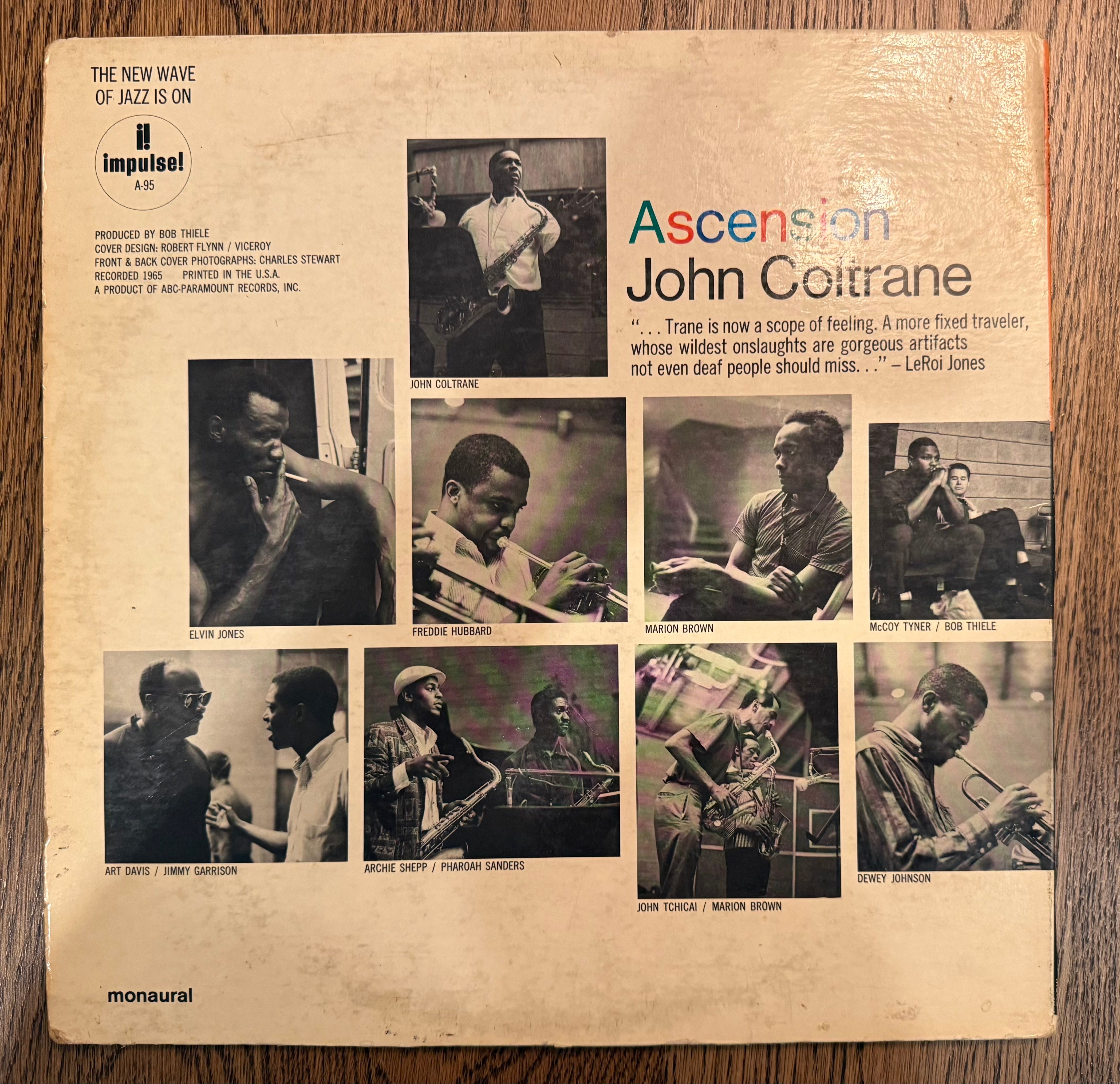
This is the real sheets of sound. I know Ira Gitler coined that phrase back in the fifties, and I know he meant the earlier Coltrane, those cascading runs where Coltrane shreds apart chords on the Blue Train and Giant Steps records. But to me, at least, I don’t think it gets fully realized until here, when he stops playing inside the parameters and lets the whole thing loose. A room full of players pouring everything out at once instead of one man’s arpeggios.
And then, somewhere, years later, along the way, it clicked. I’d had this exact reaction once before.
I was 13, and it was Minor Threat’s Out Of Step.
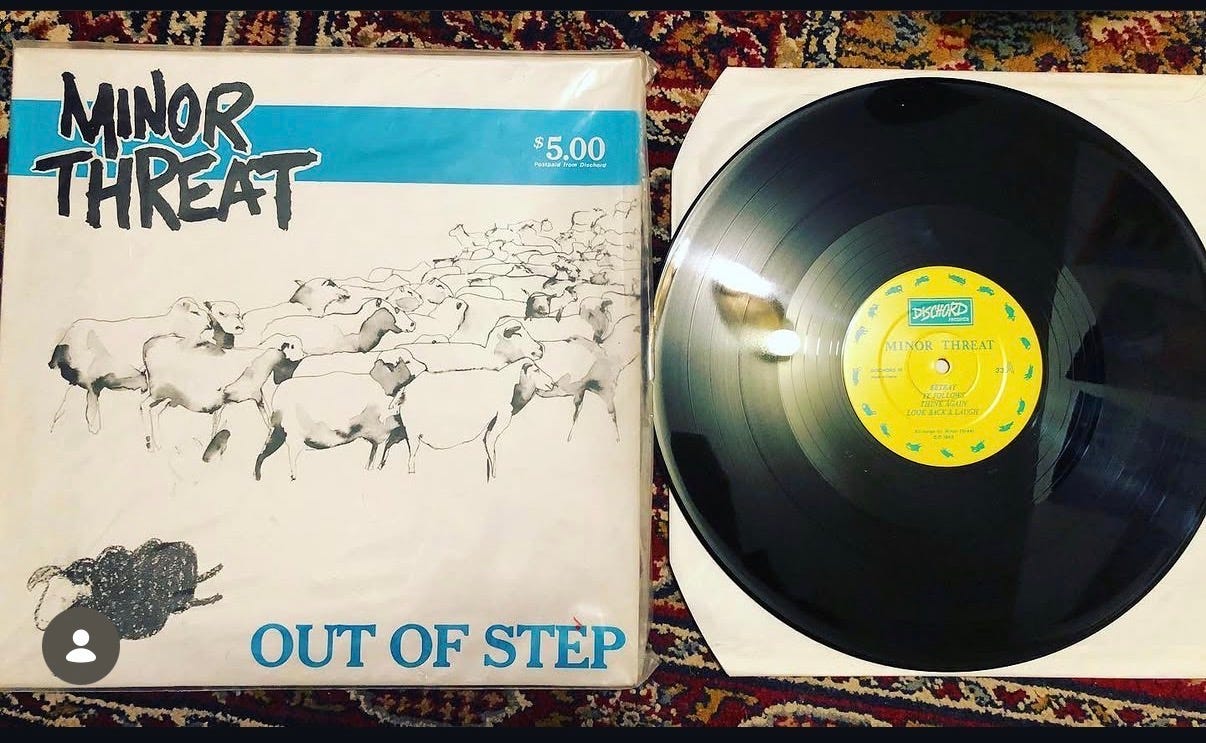
That album came out in 1983 and is a cornerstone of punk and my coming of age. When I first heard it ten years after it came out, I couldn’t believe this was the same dude fronting Fugazi. It was like, whoa.
I still remember hearing it for the first time when I was 13. It was like nothing I had ever heard. It was fast. It was loud. The instruments were abrasive, aggressive. And the singer didn’t sing, but yelled, screamed, and lost his mind. And yet it was focused and driving, with a momentum that met my onsetting teenage years with equal force, clarity, and noise. Minor Threat was the first hardcore punk band I ever heard, or at least the first I remember hearing. I devoured the lyrics so that when I cranked the volume past 11, it would be a secret language that I alone understood in my alienated landscape of development suburbia in Delaware. I tacked the insert up on my wall (inspired by the skate bedrooms in Gleaming the Cube). The music was explosive and full. It surrounded me like an earthquake.
It took me a long time to work out what that experience with Ascension was like.
My reference points with Coltrane were limited. I came in through the front door, the Coltrane everybody knows, and I had no vocabulary and no history when Ascension hit me. But, understanding the divergence that Ascension represents, I’m thankful I started with Giant Steps. That expectation made the shock of Ascension so much stronger. Having a reference point to break makes that breakage, that shock, possible.
And there are two different things that can happen when a record breaks something within you. One is offense. That’s the feeling that a rule has been violated. “This is wrong.” “This isn’t music.” The other is astonishment, which isn’t “music shouldn’t do that.” Instead, it’s “I didn’t know music could do that.”
Mine was astonishment. Both times.
Ascension never struck me as wrong. It was like seeing a hurricane for the first time. I had nothing in me built to take in something operating at that scale, and I couldn’t look away from it either. Same thing at 13. Minor Threat didn’t offend me. It opened a door I didn’t know was there. It did startle me. It startled me the same way a hurricane barreling down on you does. It got my attention. It made me brace for impact until I learned I could fly along with it.
The offense belonged to other people. And seeing that helps me find the link between these two styles of music: their transgression.
I want to be precise about it, because transgression isn’t the same as different, and it isn’t the same as experimental. Transgression needs a rule to break, and it needs somebody holding that rule who feels it give. Coltrane experienced that. Critics called this stuff “anti-jazz.” Audiences who had followed him for years, who loved him, got vocal about what the hell he thought he was doing.
This wasn’t the first time it had happened in jazz. Amiri Baraka’s argument in Blues People is that bebop was built the way it was partly to be hard to copy, after swing had been absorbed and watered down by the white mainstream. Every time the music got accepted and taken, something came along that supposedly “shouldn’t be.” It was a rejection of musical stagnation and co-option. It was a reaction to alienation. It was a search for self and collective discovery and freedom. Jazz started this way, and bebop and free jazz were arguably the biggest examples of this within jazz itself.
Punk ran a similar pattern. Punk emerged as a rejection of the mainstream and commercial rock and pop of its day. Punk gets picked up and sold back, so you get hardcore. Hardcore hardens into its own orthodoxy with its own gatekeepers, so you get whatever came next, which in my corner of it meant bands that expressed power through means other than raw explosion and let feeling into it, and got mocked for that by the same scene that had itself been mocked ten years earlier. I saw this firsthand, playing in early “emo” bands (as I mentioned in my last post).
It’s also not transgressive in the sense of mere provocation. It’s not simply shock value (which, if I’m being honest, is how I always saw some punk acts, like the Sex Pistols). It’s not performative or role-playing. It’s a transgression that arises from the music’s emotionality. It is not a costume to put on, but rather a life to express.
That’s a thread I keep pulling on, and it’s where these two musics, punk and jazz, actually meet: music as transgression.
A.B. Spellman was right with his liner note advisory. I was more startled by Ascension than I was by Minor Threat. I wasn’t ready for it. I put it back into my collection and returned to the earlier periods of jazz (when I would listen to jazz at all). It wasn’t until recently, about two decades later, that I found myself ready to come back to that discomfort with a curiosity to understand it.
As I mentioned in my first post on this blog, it was after a trip to Portugal in 2023, where I wandered into a record store and felt lost amid the collection of records from around the world. All sorts of jazz, but much beyond that, too. All of a sudden, as someone who felt their life had been defined largely by music, I realized there was so much more to learn and experience.
I came home and started to dig in. Since 2023, I’ve taken a dozen jazz classes via Jazz at Lincoln Center, read dozens of books, gone to concerts, watched documentaries, and bought hundreds of records: Mingus, Ornette Coleman, Pharoah Sanders, Alice Coltrane, Don Cherry, Albert Ayler, Sun Ra, Archie Shepp, Cecil Taylor, and of course, much more Coltrane, among many others. And I can hear what’s happening on that record now in a way I couldn’t then.
Four questions have been driving all of this. Where does this music come from? How does it differ from what came before it? Why does it differ? And what is it all about? I’m not finished with any of them.
As I dove deeper into jazz, one of the things that kept striking me is the resonance between jazz, especially the free/loft jazz of the 1960s-1970s, and the DIY punk I grew up with. This blog, in part, is part of how I’m thinking it through.
Ok. Some caveats, because I want to be clear about what I’m claiming here.
I’m not claiming a direct lineage but rather exploring resonances. Punk has plenty of well-documented ancestries, and I’m not trying to displace any of them. Rock ‘n’ roll, garage, the Stooges and the MC5, early metal, dub, some reggae. Anybody who wants to tell me punk came out of rock is right, of course.
But if you follow that line back far enough, you go from punk to rock ‘n’ roll to rhythm and blues to the blues itself. And when you trace jazz back, the blues is sitting right there too. This is not a lineage claim, to be clear. I’m not drawing a line from Coltrane to Ian MacKaye. But it does mean these two musical forms are distant branches off the same root, and that the family resemblance I keep hearing isn’t coming out of nowhere.
And there are other distinctions I don’t want to hide. Free jazz (and jazz as a whole) came out of a Black American musical tradition and Black liberation politics, and the DIY punk I grew up in did not. Also, bebop and free jazz musicians, whether Bird or Monk, or Coltrane, Coleman, or Shepp, were formidably trained musicians breaking rules they had completely mastered, where punk’s whole founding premise was that formal training and instrumental mastery was a gate you didn’t need to pass through. And bebop and free jazz are built on improvisation in real time, individual in the first and collective in the second, whereas for punk, even if songs written through some form of collective improvisation, they ended up written nonetheless, and then played more or less the same way night after night.
Those distinctions are real. But I keep coming back to the continuities anyway.
As you can tell from my posts so far, the perspective I’m bringing is, for the most part, a punk understanding of jazz. Not a musicologist’s, or a scholar’s, or someone who grew up in the jazz scene.
So what is it that I want to get into? I want to explore how the infrastructure of both scenes was built when nobody else would have them, the labels and zines and distros and the spaces run out of lofts and basements and apartments. How fast the bands burned through and died in both, and how the same handful of players kept turning up in new configurations. The politics. What’s actually happening in the music itself, the harmony and the meter and the timbre, where the two converge and where they don’t at all. And one that my friend Joshua flagged for me: while most guitar players and bass players in punk learned by ear from their friends, most drummers learned in school, and what they learned in school was jazz.
But I wanted to start with the sound because that’s what hit me first. Abrasive. Caustic. Hard to sit with. Structured chaos. Music that isn’t asking to be liked. You don’t land on a sound like that by accident. You get there by refusing something, and both of these musical styles were refusing, in part, the same thing. A mainstream that had already decided what music was supposed to sound like, who was supposed to make it, who was supposed to own it, and what it was for.
But refusal on its own is a wall, and what I keep hearing underneath it is something else. People are trying to find a purer way to get at what they actually feel. To put the deepest part of themselves into sound without sanding it down first, without translating it into something more agreeable on the way out. Which is why it comes out abrasive. The feeling itself was abrasive.
Still, the most uncompromising music that both of these scenes produced was made to be released. This implies a hope that it will land on somebody else, and that they hear the thing you couldn’t say any other way, and that, maybe, at least for the length of the song neither of you are alone in it. Even within the chaos, screaming, or sonic assault of Ascension or Out of Step, the music was about building connection. Connection both within the band and across human experience. And building on that connection is what I’ll try to do further here.