

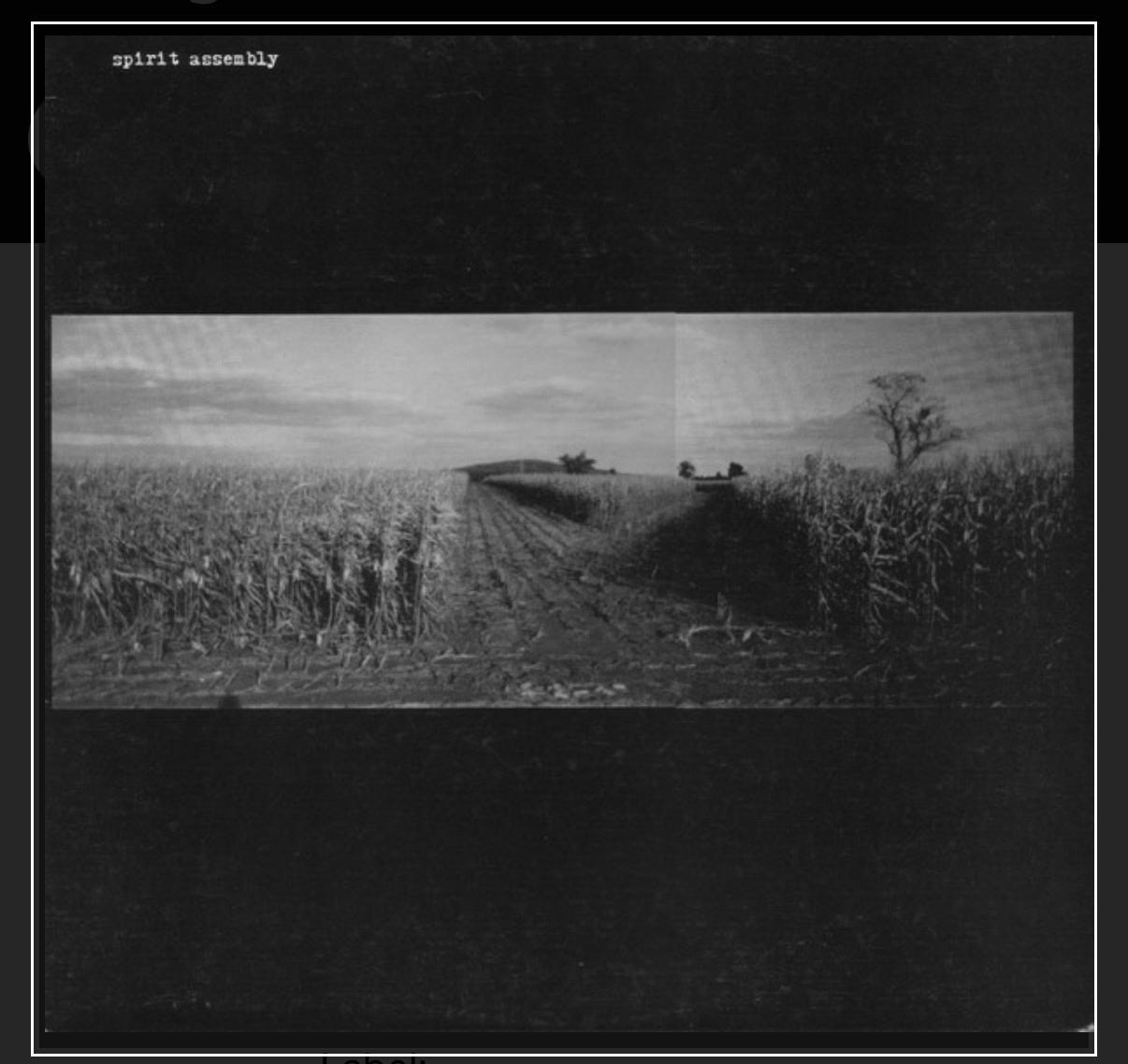
Album: Welcome to Lancaster County
Artist: Spirit Assembly
Label: Yuletide Records (1996)
Runtime: 8 songs, ~23 minutes
Ok. So this is the one I want to start with.
It was 1994 or 1995, and I was 14 or 15, the first time I saw Spirit Assembly. It was a room in Newark, Delaware, on a bill I’m pretty sure had Policy of Three on it. There was no stage. There almost never was. The three of them set up near one end, we stood a few feet off, and a song in, the gap between the band and the rest of us was just gone. I’d been going to shows for a few months by then. But it was already long enough to know I loved this. What it was doing to me, I wouldn’t figure out for years. Not sure if I ever have.
So, as a way to kickoff my “perfect punk album” series, I’m starting with one close to home: Welcome to Lancaster County by Spirit Assembly. Their only full-length, eight songs, clocking in at about 23 minutes, released in 1996 on Yuletide Records. You can’t stream it. It’s not on Spotify, Bandcamp, Apple Music, none of that. If you want to hear it you gotta check out a YouTube rip. Or, you can check Discogs and try to get the real thing. In part, this is why I wanted to start with this record. In an era when you can pull up almost any record ever made in about four seconds, this is one you have to know about and go find.
I should tell you first that I grew close to this band, because if I’m honest it’s all over everything I’m about to say. At that first show I bought their 7”, Old Joe the Eternal, and I saw them over a dozen times after. I played shows with them, booked shows for them, got to know them off the show floor, and the short version is they were solid guys. The kind you were lucky to have been a teenager around and come up in punk with. I remember Sam was a high school teacher and I was like damn, how lucky are those kids? What’s he like in class? Later, after Spirit Assembly was done, and after my own run of bands with my best friend Tim on drums was done as well, Tim formed Fields Lay Fallow with a couple of them. I was around for that at the start too, including in New York while they recorded. So, I’m not coming to this record cold. I never could. (And if I’m honest, I think that trip to NYC with them firmly planted my desire to move to NYC which I did in the summer of 1998. I remember sitting in Dojo’s on West 4th Street together and being like, wow, I need to be here…but I digress).
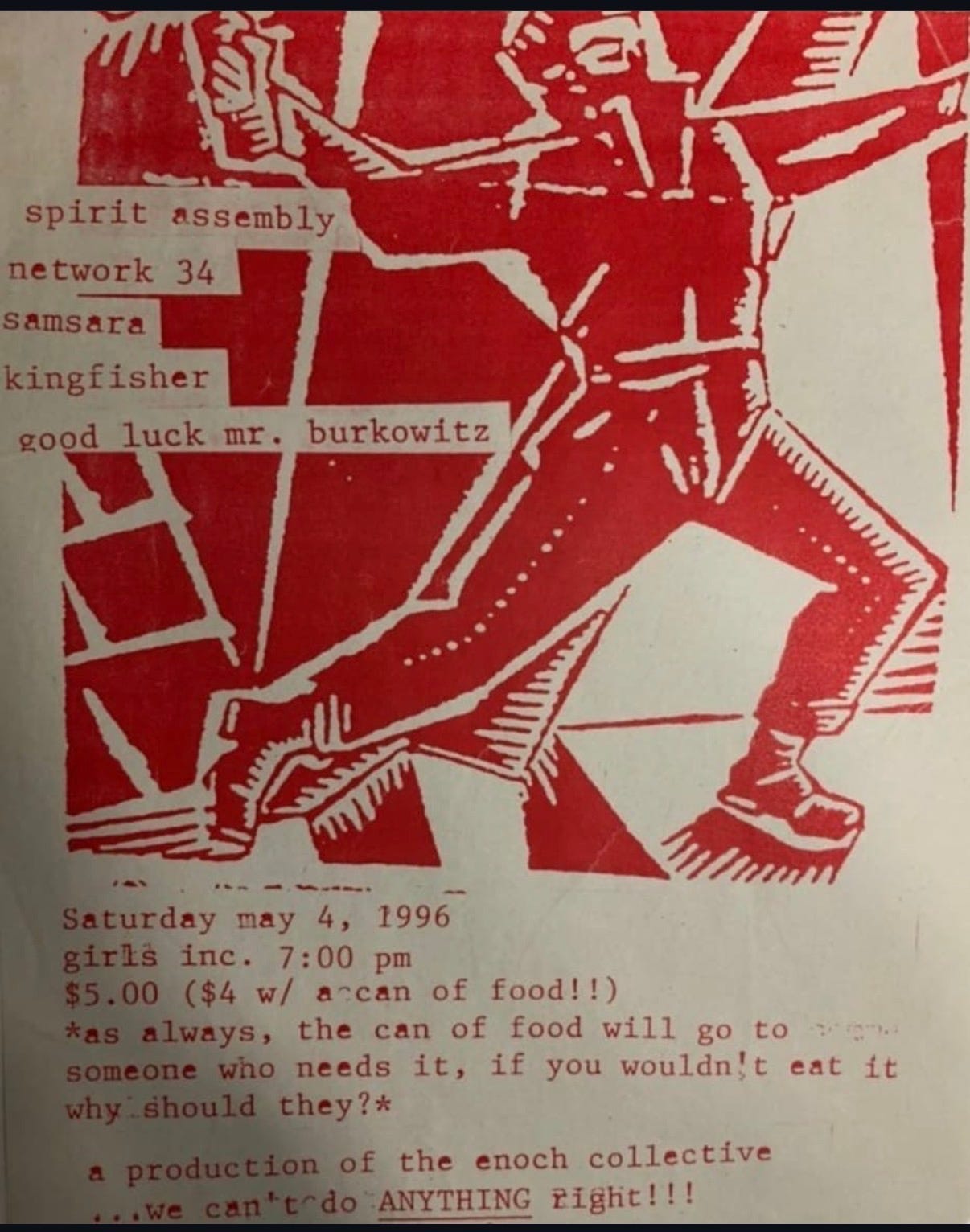
(a flyer for one of the shows I put on and played with Spirit Assembly)
There’s something else I have to talk about when it comes to music before I can write this. And it’s something that runs across anything I write here. A record is a time machine. You drop the needle, you press play, and it hands things back to you. It excavates. It pulls things, memories, feelings, ideas, out from somewhere within you. I don’t think we recognize it consciously at first, if at all sometimes, but it’s there. The first time you heard the song. The kid whose bedroom floor you were sitting on. The person who put it on a mixtape for you, especially if you had a crush on them. What you were going through at some point while listening to it. Any and all of that. I can’t put on Welcome to Lancaster County without some of that coming back: the inserts we read till we’d memorized them, the groove we wore down to nothing. Bringing it to my then-girlfriend’s house and playing it for our friends for the first time. The memories of hearing these songs live. Dru’s arms flailing around, Gus dancing and smiling, Sam yelling with urgency. For a long time I figured that was a problem for a series like this, all that personal weather fogging up the record. I don’t anymore. It’s just how anybody lives with music. Nobody hears anything from nowhere. And the record won’t sit still while you get older. It keeps coming back around. Something almost thirty years old can hand you a version of yourself you’d lost track of, then turn into a slightly different record the next time through, because you changed, and even if it didn’t, it seems like it must have. It’s not static. Even though an album is a particular recording of a particular moment, it’s a living art. You can generate a new relationship to a song, an album, than one from the past. It can anchor and invoke and it can evolve and generate. This one does all of that for me. It also flat-out stands on its own without any of my personal attachments. Both are true. I’m not going to pretend otherwise.
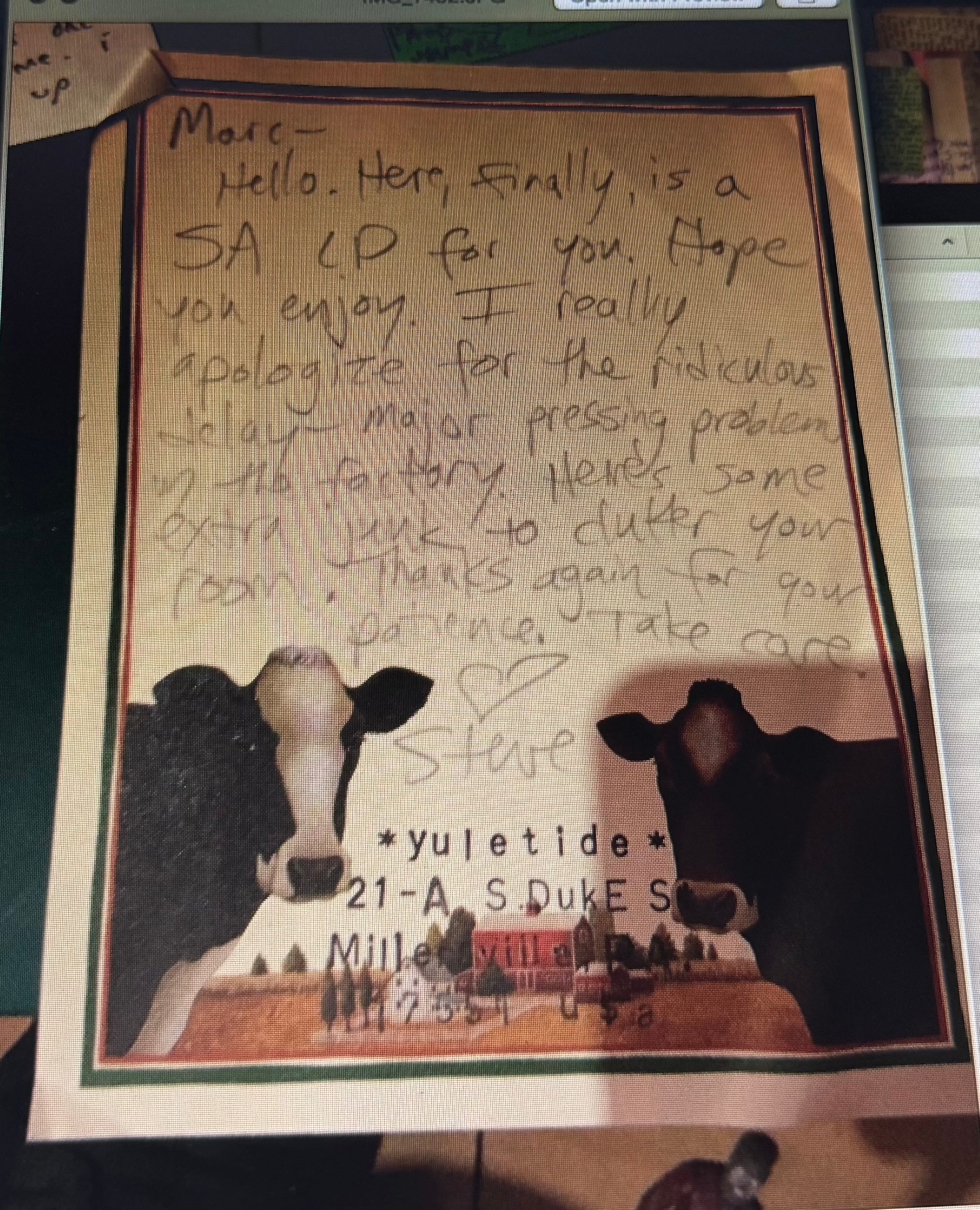
(My letter from Steve who ran Yuletide accompanying the copy he sent me of the album)
So, as my first post in this series, let me explain what I mean by perfect. It doesn’t have to be the band’s best record. It doesn’t even have to hold their best song. Here’s the whole test: there’s not one track on it you’d skip. And this one holds up. Eight songs, every single one earns the spot. That bar is higher than it sounds, and streaming has half-trained the skill out of us, feeding us a song at a time until the album as a thing nearly disappeared. The apparent brevity with this one - 23 minutes - is the point too. The band says its piece and gets out. There’s an economy to it I came up believing in. You earn somebody’s time, then you give it back. It’s lightning in a bottle, or in this case, on vinyl.
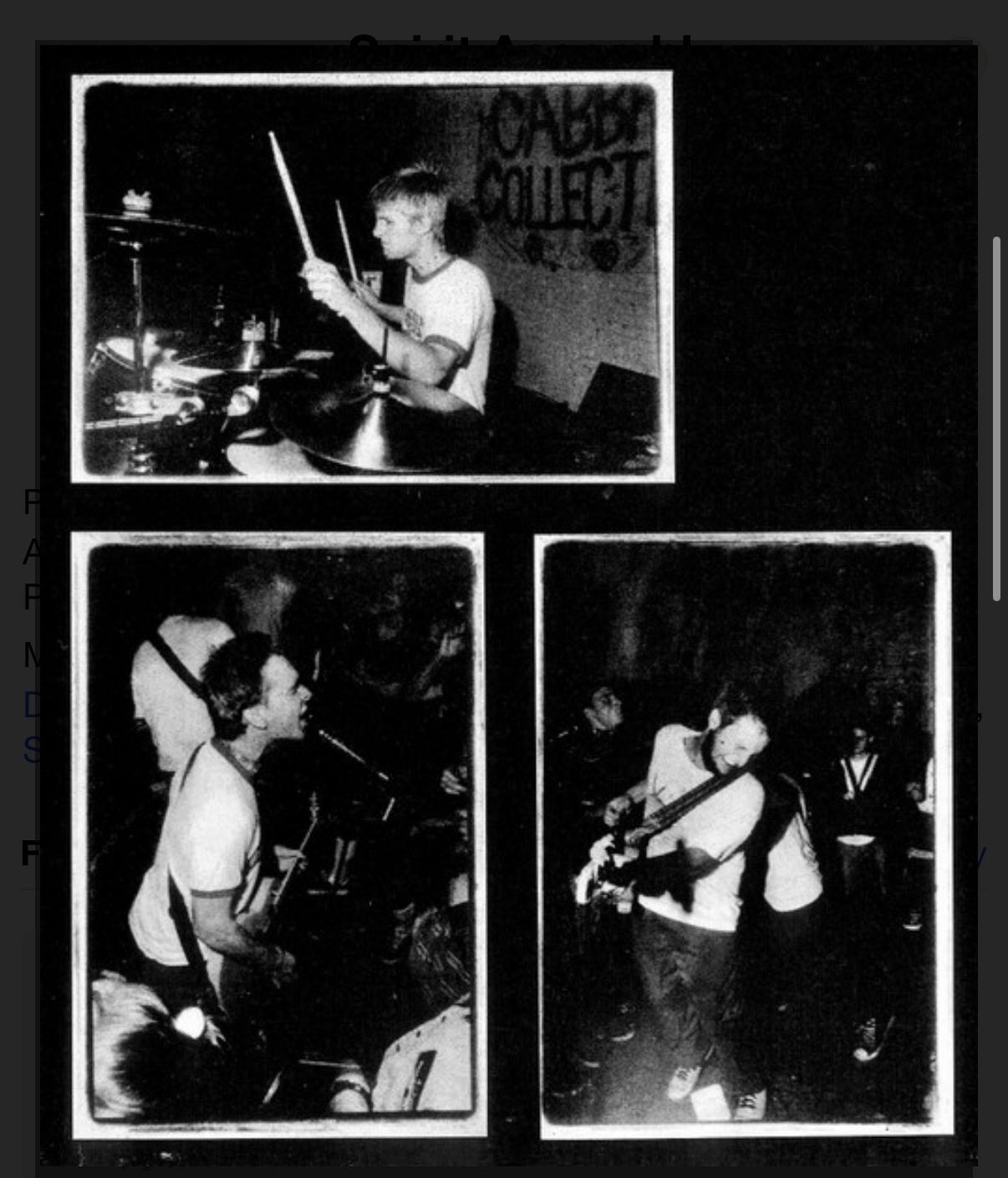
First thing everybody notices about this record, (other than the kinda haunting sample of a kid talking about a blood draw that kicks the record off or once they get past not being able to even find the record) is that it sounds huge. And yet there are three people making it. You’d swear there were five or six of them crammed in the room. A lot of that is what happens when there’s only three of you and nobody gets to just hold down their one corner. The drums aren’t keeping time so much as articulating the album’s dynamism and urgency. The guitar covers an immense amount of ground on its own, swinging from discordant yet melodious riffs to thrashing chords. And the bass is pulling double duty, holding the floor down while it walks a melody over the top. And on top of that, the vocals criss-cross throughout. The vocals are used as instruments. They demand your attention and exhaust themselves in the process. That’s the engine of the album. Three people each playing like a person and a half, which is how a trio ends up sounding like a much bigger band. This fullness existed live and this record captures it.
I’ll try to show how they do this with two songs off the album. The first is “Continuity W/Out Question.” The song opens on a guitar chord riff, with the drums and bass punching accents alongside it. The chords sound like an air raid siren hitting in short bursts. The bass serves as the shelter. The drums are like the bombs hitting. Then it does what makes this record. It drops. Not into a quiet part, but into something cleaner, jangly, almost upbeat, the guitar left ringing. However, the notes sound almost wrong, and yet, are that way on purpose. Angular. Dissonant. They’re the kind of clustered, off-kilter voicing Monk would play on a piano.
What Spirit Assembly does so well and is captured here is that the loud part isn’t where the tension is. The clean part is. You hang on those ringing, sour notes like a rope pulled taut. Strip the distortion off and the unease climbs instead of easing, because now every wrong note is out in the open with nothing to hide behind. Vocals come through nearly breathless. It’s a break in the alert trying to get a message across to you before everything crashes again. Then the heaviness comes back and you’re launched. Swinging out on the line you were just gripping. And that’s the exact moment the double vocals hit as the chords slam back into distortion. They save the fullest, most kinetic vocal moment for the release, not the tension. The voices are the sound of letting go.
“Nameless” does this as well but through a different approach. It opens on bass chords, followed by hi hats, almost like a call and response. Then the guitar comes in with single notes picked out over the top, the pitch sitting a hair off true, and Dru lets loose on the drums. He plays them not quite setting the time but the melody. Which is already a strange, good inversion. It starts slow. It builds. And once it’s up to full speed it just stays there, the whole band moving in blocks, Gus swinging chords instead of picking out lines. Which is a lot of why three people fill a room like five. Nobody’s playing small.
Then, for me, there’s the move that makes the song, and it’s easy to miss if you’re only listening for volume. Everything stays loud and nothing pulls back. But the drums cut to half-time inside a single measure, the syncopation yanking the floor out from under a song that never actually slowed down. You don’t really hear that drop. You feel it. Live, it was the thing that threw my chest forward and back, the count lurching and my whole torso heaving with it, and the record still does it to me now, decades on, sitting down or walking or wherever I am. Late in the song a quiet part opens up, then the loud ending comes crashing back through. And it closes the way it started. On the bass, alone.
The double vocals on “Nameless,” screaming around each other the way I remember them live, add rhythmic push and color. The words are doing their own work too, braided into the music instead of laid on top. “Nameless” is personal and political at once, the way the best of this scene always was, and the subject is how often heterosexual men move through the world in constant sexualization of women. “I’ll disengage your wretched excuse for a man / it makes me so ill / the ultimate body? / why can’t you hear her mind? / not what her body supposedly says / your grip attempts to hold me down / but the struggle strives on in me / I’ll never let that die / I’ll take you down.”
These two tracks, to me, capture the album’s whole method. “Continuity” builds its tension out of harmony, the clean jangle and those Monk-like “wrong” chords, and the release is the swing back into distortion. “Nameless” builds its tension out of time, loud the entire way, the floor pulled out from under you by the drums alone. Same idea, chased down two different ways.
These dynamics - angular and dissonant guitar, melodious and thick bass, musical and textured drumming, urgent and breathless vocals and screams, composed in songs that swing from quiet, clean, and sometimes caressing like a whisper to surging, syncopated heavy sections - give this album its signature.
That’s what I mean about no skippable song. Every track here is good, sure. But more than that, the record keeps turning up a new way to do it.
The not-on-streaming thing gets stranger the more you trace the impact of the band. While they never got famous, they did something more lasting. You can draw a straight line to a ton of bands inspired out of this one trio. Spirit Assembly were quietly, hugely influential and almost completely uncredited, a band a lot of other bands came out of without ever saying so. So, part of what this post is, honestly, is just preservation.
I keep landing back in that room in Newark. The band on the floor, me at 14 or 15 with zero idea I’d still be turning this over thirty years later. That’s the time machine again. The record’s a way back to that kid, and it’s still teaching the older me, because every time I think I’ve finally got it pinned, it comes up new. So if any of this makes you want to hear it, good. You’re going to have to work for it a little. Ask somebody. Follow a link. Find it the slow way, the way we all used to find everything before it got handed to us, which was always part of how this music got under your skin in the first place. It made you come to it. So go find it. It’s worth the work.
hello,
Commenting as a person of the same age as you growing up in a different continent and enjoying your output. I bought this record while travelling in Toronto in 2018 after hearing about it for years, playing it back at home and not enjoying it as much, thinking something like "I need to check it out again later because it probably takes time to get into it". I still have to do it. Life is strange, I only started going to punk shows a few years later than you, but the band Fiya fron Florida really had a huge impact on me back in 2005. That same year, I was really into the band Tiny Hawks. Turns out both of these bands have ex-Spirit Assembly members. I really need to check it out again then. Thanks for all the reviews / Cédric