
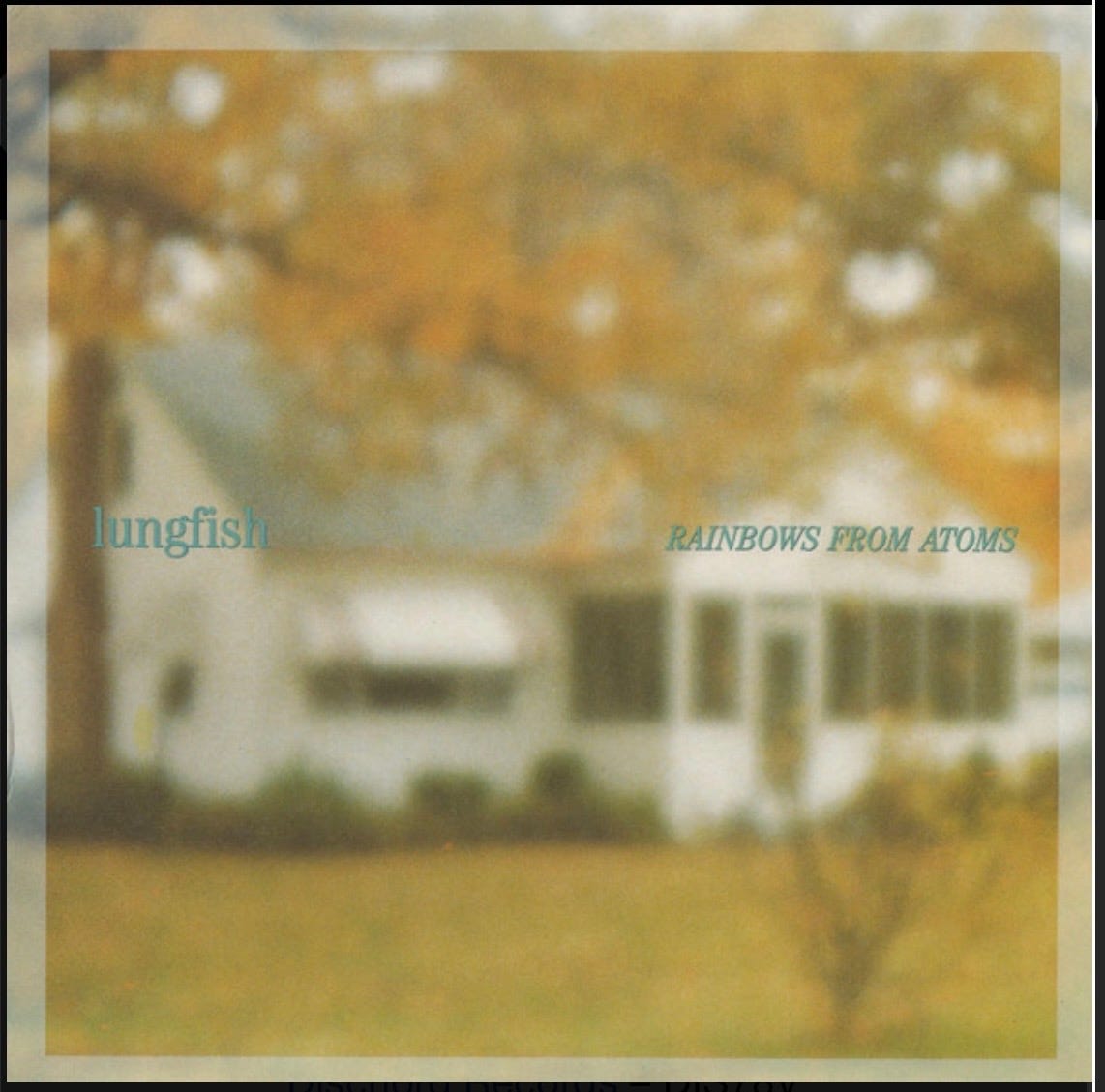
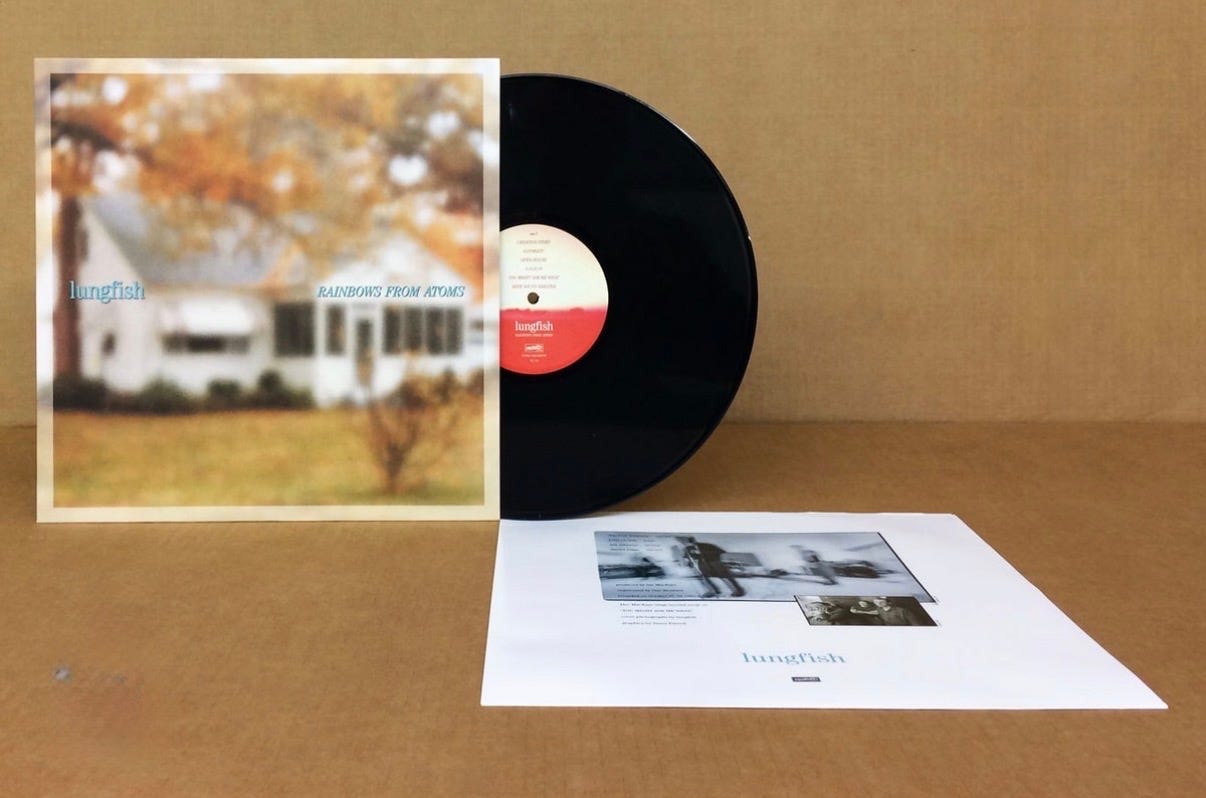
Album: Rainbows From Atoms
Artist: Lungfish
Label: Dischord Records (1993)
Runtime: 11 songs, ~40 minutes
So, I’m now three entries in on this perfect punk album series, and I think this may be one of the most controversial selections I’ll offer. Who knows, though. I’m often surprised. But I figured, I don’t want to wait on it; I want to throw this out now, and see what happens. It’ll keep me honest and push me to keep digging deep to articulate why I select what I select. I’ll warn you: this is a long one, so dig in when you have the time.
The first one I wrote about, Spirit Assembly’s Welcome to Lancaster County, is beloved but undervalued in large part because it’s been intentionally kept off streaming services. But it was important for me to start with one that was close to home and wouldn’t be an obvious choice except for those who grew up with them (don’t worry, there will surely be a Fugazi entry). The second one, Sunny Day Real Estate’s self-titled album, or LP2, or The Pink Album, as I called it, comes from a scene heavyweight, one where it’d be a shock if they weren’t included, albeit most people talk about Diary. This third selection, Rainbows From Atoms, from the Baltimore natives and Dischord Records stalwarts, Lungfish, I suspect, may raise some eyebrows. So, let’s go.
The reason I suspect there will be some controversy is that while some friends love Lungfish, they have a reputation not just for repetition but for monotony. The standard critique is that if you’ve heard one Lungfish song, you’ve heard them all. That their albums bleed together. And while I think some of that reflects a laziness on the listener’s part, I get it. There is repetition within their songs, and a familiar motor that drives across many of the tracks. And for a series on perfect punk albums that’s built on one test, no skippable track, Lungfish’s musical style puts my test to the test.
First, some background. Lungfish has been a constant. They’ve put out 12 albums from 1990 to 2012. For me, when I listen to them, I hear Baltimore all over it. It brings to mind, for instance, the dissonant runs of Tonie Joy (Moss Icon, Universal Order of Armageddon, Born Against). Baltimore has continued to produce angular, trance-leaning music to this day, as seen in the soundscapes of the avant-garde, jazz/post-rock band Horse Lords. It’s Baltimore punk to me. And growing up in the scene in Newark, Delaware, this loomed large.
I actually found Lungfish through my older sister, Melissa. In fact, she was the one who found the door to punk for both my brother and me. She propped it open, and then Matt and I barged on through. Not only did she do this by the handful of albums she had, but more through her friend network. She gave us immediate credibility in the scene (never mind even making us aware there was a scene!). Of course, Matt and I had to find our own way, but at the very least, we weren’t met with contempt or dismissal when we showed up. Since she was cool, we were given a pass. And when you’re 14, and everyone else is 19 to 25, it means everything. It was acceptance.
I would often sneak into my sister’s room when she was out (which was often), and go through her CD collection. All these bands, with such strange names at the time: Samiam, Jane’s Addiction, The Cure, Poster Children, Jawbreaker. That’s how I first found Lungfish back around 1993, and their 1992 album (and first on Dischord Records), Talking Songs for Walking.
I was drawn in immediately. But it wasn’t until the last five years or so, and, truthfully, not until I was in my free jazz and spiritual jazz deep dive, which brought me to Indian ragas, that I could truly appreciate them. Because here’s the thing about Lungfish, and about Rainbows From Atoms in particular: the repetition is the point.
With Lungfish, you know what you’re going to get. And there’s nothing wrong with that. Yes, it can feel repetitive. But it’s meant to be. It’s meant to be meditative, a way to lose your sense of time and place and self inside a rhythmic sound. The repetition is the design.
Which is exactly where it collides with my test. The whole point of a Lungfish record is to sink in and lose yourself, to let the tracks blur into one long meditative flow. But “no skippable song” asks the opposite question: does each track stand on its own? Those two things look like they’re in tension. A record built to dissolve into a single entity shouldn’t also be a record of eleven distinct songs. And yet, Rainbows is both at once. You can let all forty minutes run as one continuous thing, and you can also find each track holds its own shape. That’s how it passes.
Understanding Lungfish the way I do now helps me make sense of the lasting impression from when I got to see them and play with them back in 1996.
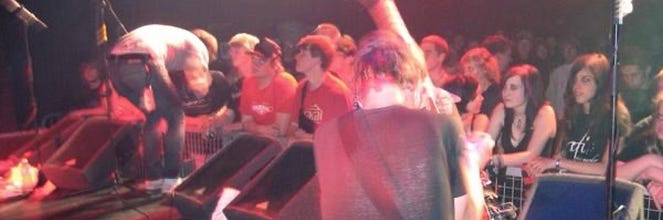
The show was in Delaware with my band Network 34, in a church hall. There was a stage in the hall, but all the bands of course set up on the floor. I was a teenager. They were not, and that was the first thing that hit me, before a single note. These were actual adults. And on Dischord! They were legit. Grown men, calm and a little remote and cool in a way that had nothing to do with trying to be. It was honestly kind of imposing. And then they started. Higgs stood up there with his voice, his hands and arms, covered in tattoos, moving in slow, incantatory shapes over the top of the drone the other three were building, and I swear a spell was being cast on the room. It was hypnotic. It was also, if I’m honest, a little unsettling. I didn’t know whether to move or hold still. I took photos that night, and even looking at the stills months and years later gave me the same feeling. I’ve seen a lot of bands and played a lot of shows, and that is still one of the strangest and best experiences I’ve ever had in a room with a band. A séance is the word I keep coming back to.
That’s the spirit of it, and it’s also written all across Rainbows From Atoms. I want to get into the mechanics of the songs though, because the drone isn’t just a mood, it’s built, and in examining this we can understand another approach to art and music.
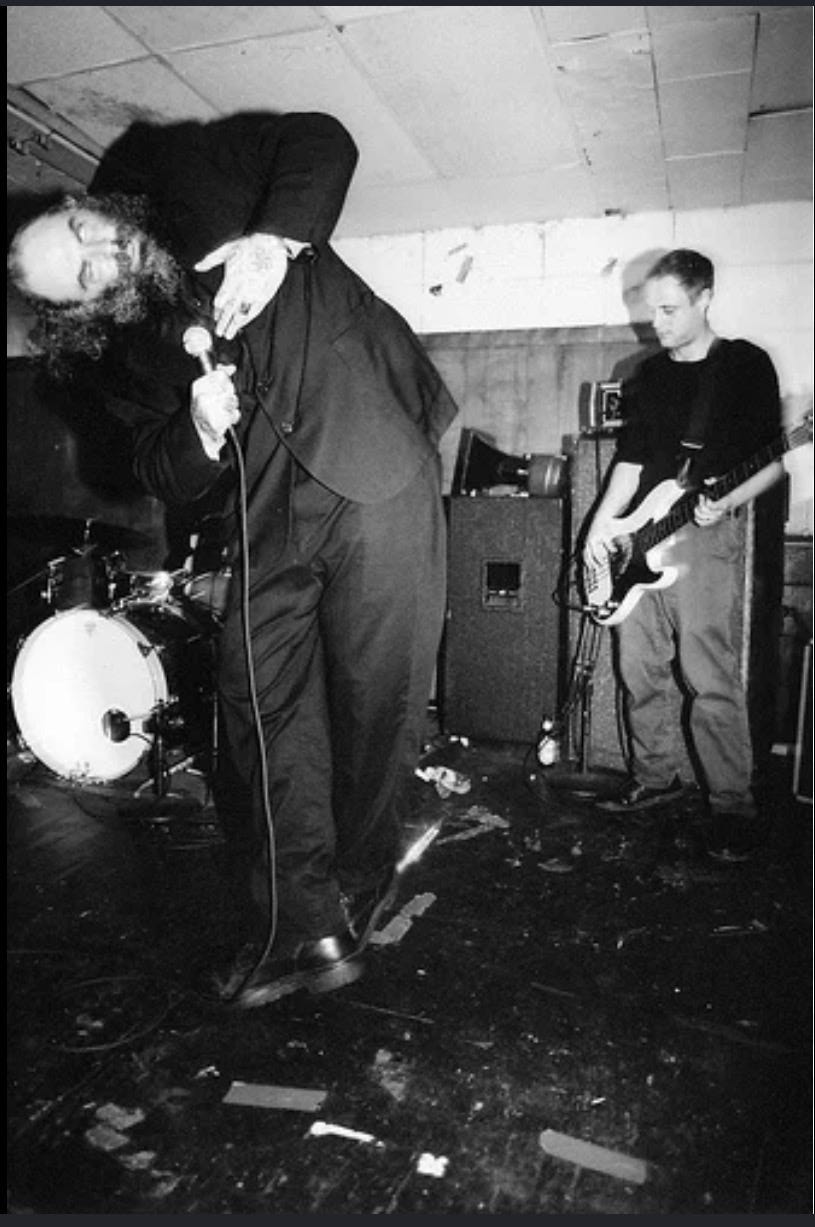
First off, the thing that keeps all that repetition from going flat is the groove. It’s not drone for drone’s sake. The bass gives bluesy lines. The guitar plays octaves up and down the fretboard. So the part that’s repeating is already full of motion and weight, which is exactly what lets you fall into it without it ever going dead. A single beat repeated is monotony. A deep groove repeated is a trance.
I had no words for the droning quality when I first heard them at 13 or when I played with them at 16, but do now, because of my recent deep dive into experimental jazz. It’s the same thing a good Indian raga does, and the same thing the spiritual, Eastern-facing end of jazz does. John and Alice Coltrane or Pharoah Sanders’ explorations that rather than being about chord changes, are about staying in one place until it cracks open. Using that repetition as a meditative, even metaphysical, reaching for something beyond yourself.
You can hear the method announce itself in the first song. “Instrument” kicks off on spiraling guitars and a long vocal howl, Higgs’s voice quavering as he bends it downward and holds it out there in the air. No words yet. Just tone. My head bobs along, my feet move, immediate and involuntary.
Then comes “Abraham Lincoln,” layered vocals stacked on the chorus, the guitar clean but with the gain pushed up and the reverb wide open, so the whole thing swirls around your head like weather. The bass walks, and your head goes with it, back and forth. And the drums do most of their work on the hi-hats, building the rhythm as atmosphere instead of assault. No blast beats. No big crash cymbals. Which is its own quiet argument about punk, and one I’ve come to believe in: you can have every bit of the energy and the power without a single blast beat or cymbal crash. Power is a feel, not a volume.
This is also a song where Higgs’s words push up through the wash and grab you. “Will you resist the burning urge to burn? / Will you refuse your right to choose your type of execution? / That cushion that you’re sitting on.” Most of the time, you’re not parsing his words; you’re receiving them, the way you take in a chant. The words aren’t information. They’re one more loop. But every so often, one surfaces clean and lands, and it lands harder for everything around it that didn’t.
And then, so as not be pinned down as pure mystic drone, they throw “Animal Man” at you. For me, it harks back to the post-punk of the late seventies and early eighties, almost a Talking Heads kind of vibe, jittery and bright and a little funny. There’s a playfulness to it. The fun is what keeps the seriousness from tipping into drudgery.
Line up “Instrument,” “Abraham Lincoln,” and “Animal Man,” and they’re unmistakably the same four people doing the same thing, and they’re also, clearly, three different songs reaching in three different directions. The sameness is real, and the distinctness is real, both at once.
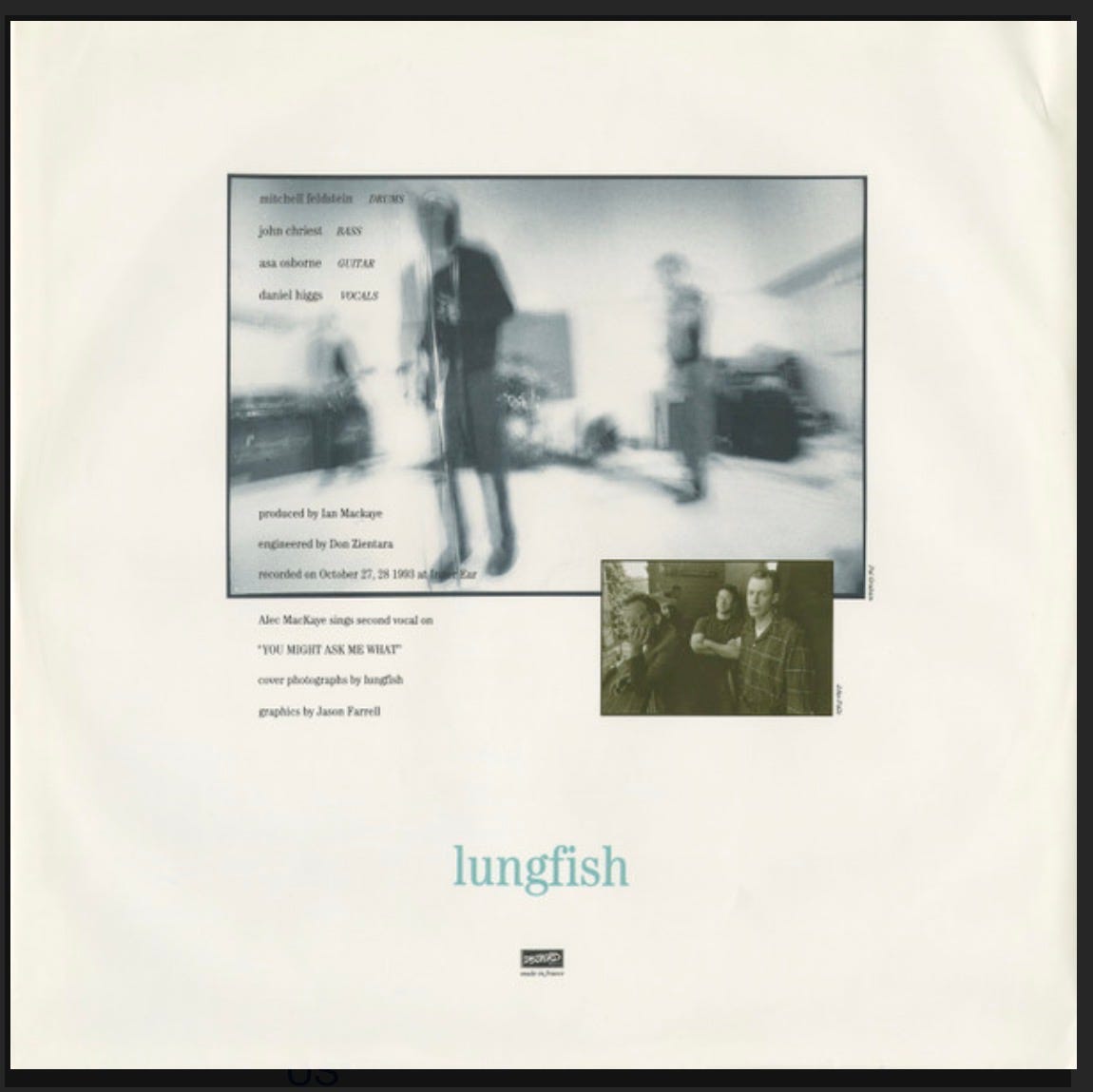
Then, there’s “Fresh Air Cure,” which has to be one of the best grooves laid down in punk. I don’t say that lightly. It’s the fullest version of everything I’ve been describing, the bluesy bass and the octave guitar and the hi-hat push all locked in so deep that you stop noticing the groove and just find yourself inside it. It’s the track where the sinking-in is most total and yet still playful.
“Open House” is where you should put on the headphones, because of what they do with the vocals. Higgs’s main vocal comes up the left channel, and a reverberating echo of it answers from the right, so he’s on one side of your head singing across to the other. It turns your skull into a room. Or better, a cave, a space you go down into and explore.
“8.14.2116” lets the guitar fly. Where the rest of the record builds its drone horizontally, this one goes vertical, layering guitar over guitar until the tracks smear into a single spiraling thing. And it points forward as much as back. You can hear it setting a path toward what someone like Bill Orcutt would do years later with spiraling, abstract guitar. The raga was the ancestor. This is the descendant, showing up early.
The intro of “You Might Ask Me What” always stuns me. What on earth is Chriest doing here? I sat there, a guy who’s played bass and guitar for over thirty years, thinking, “How is that 4/4?” I’d have sworn it was off-time, floating, landing in all the wrong places. It isn’t. The line is just drawn across the bar crooked, hung off the downbeat so the “one” keeps hiding, and it never once actually breaks the meter.
In my last post, writing about the Pink Album, I talked a lot about time signatures, “Waffle” dropping to 3/4, “J’Nuh” running through 9/8 and 7/8. That was strangeness written into the time signature. This is a different. The strangeness is smuggled inside standard time.
And a note on the gang vocals on the outro. There’s a MacKaye in the pile. Not Ian, who produced the record, but his brother Alec, of Faith and Ignition, DC hardcore down to the bone. Which is perfect timing, because it stamps the record’s punk credentials right as I’m about to call it something else entirely.
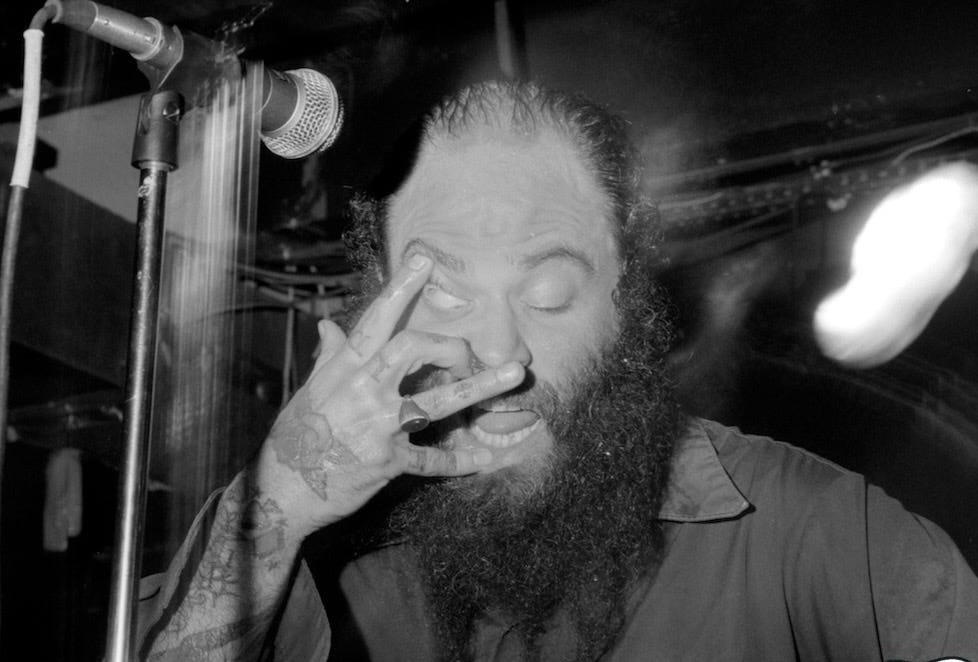
So then what is all of this, really? Lungfish was advanced art school for punk music.
Punk started simple. That was the whole premise: three trusty chords. But the music didn’t stay there. By Revolution Summer and on into the mid-90s, the stuff I’ve already written about here, Spirit Assembly, SDRE, was anything but simple. And out at the far edge, you had bands making it genuinely harder, the discordant lurch of Angel Hair, the hardcore math-rock of 1.6 Band or The Crownhate Ruin. So there’s a whole spectrum of complexity in this music.
The mistake with Lungfish, and with Rainbows especially, is to think it’s down at the simple end of that spectrum. It isn’t. What Lungfish practices isn’t simplicity. It’s subtraction. Simplicity is not having had more. Subtraction is starting with everything and grinding it away on purpose.
I’ve been revisiting Leonard Koren’s book On Creating Things Aesthetic, where he talks about making art as a set of intentional operations: combining, reconfiguring, extending, and stripping down. He even names repetition itself as one of the operations, which flips the whole monotony complaint on its head. Lungfish’s songcraft, on full display here, is a process of aesthetic subtraction.
Every album I’ve written about here has shown me something about what music even is. Rainbows From Atoms teaches a different one: that music can let you disappear.
Not play in the background. That’s easy, any record can be wallpaper. I mean the opposite direction entirely. If you let it, this record doesn’t sink into the background, it lets you sink into the background. You stop being a person listening to an album and become one more element in the loop, and for a few minutes, the whole exhausting machinery of being yourself just powers down. Subtraction, taken all the way to the end, is the self coming apart. Not as loss, but as a merging with everything by letting go of the ego.
Which is a strange thing to want from a punk record, a genre mostly built on the exact opposite. On asserting yourself. But it’s in there, in each of the elements. The record is offering you the chance to not be yourself for the length of a side. To sink in and let go. All you have to do is let it.
That’s the third in my ‘perfect punk album’ series. Let me know what you think!
As a recap so far:
#1: Spirit Assembly’s Welcome to Lancaster County
#2: Sunny Day Real Estate’s s/t (aka The Pink Album)
#3: Lungfish’s Rainbows From Atoms
And my intro post for this whole Substack: Nothing You Can Hold: An Introduction.