

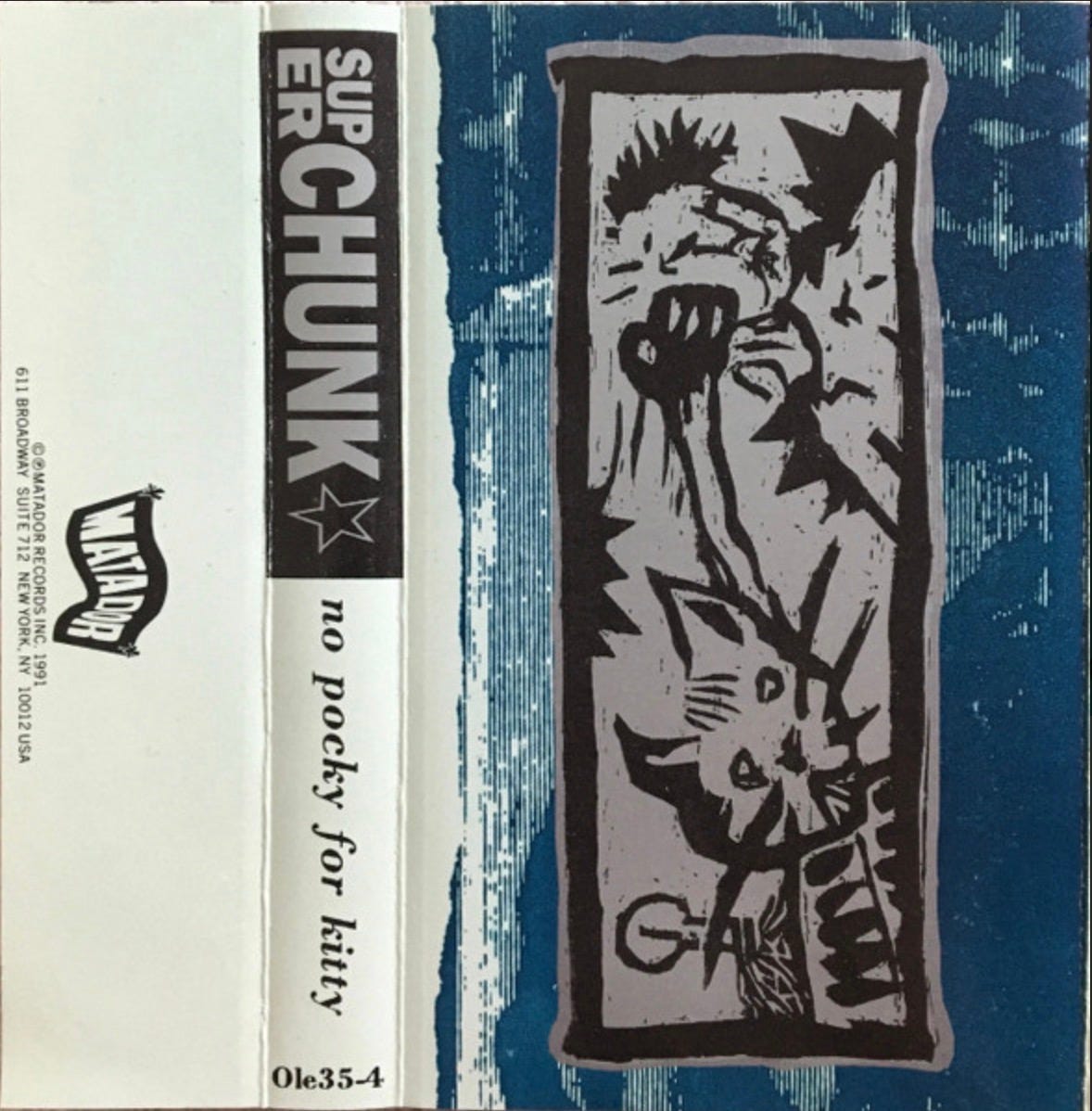
Album: No Pocky for Kitty
Artist: Superchunk
Label: Matador Records (1991)
Runtime: 12 songs, ~34 minutes
Ok. After a couple of heavier and headier posts, let’s have some fun. Which brings me back to my “perfect punk album” series and its fourth entry. The first three (Spirit Assembly, Sunny Day Real Estate, and Lungfish) were in many ways about something unexpected in punk and in my music journey. This one, in my opinion, comes straight at you. A record that isn’t asking you to work for it, and still hits on every single track.
Superchunk. No Pocky for Kitty. Their sophomore album, recorded with Steve Albini over two days in the middle of their early U.S. touring, and released on Matador in 1991. Superchunk is a behemoth in the scene. Fourteen LPs plus four LP/2XLP compilations of 7”s and B-sides. There’s a lot to consider and honestly, several I could choose from (more on that later), but I have to go with their first album I ever heard and that still holds up.
No Pocky for Kitty has no trick. That’s what I love about it. It passes the test by just being good, twelve times in a row, with nothing to excuse. Sometimes a perfect record is just a band writing twelve good songs and not missing once.
The album hits you from the first beat.
A snare kicks in, and then the guitars come down, driving power chords, and you’re launched. It’s like a ripcord being yanked. The guitars are heavy. They sound almost like they’re in a lower tuning for a second, but are driven instead by their full tone and distortion, and the engineering prowess of Albini (it gives me a glimpse of Nirvana’s In Utero, which Albini engineered two years later). The tone is thick and buzzing, and it has no business being this heavy under music this poppy. But that’s the beauty of the record.
Indeed, underneath that weight, the songs are melodic. The chords rock back and forth, that classic bouncing punk melody, and the structures are quite honestly, pop structures, hooks where you expect hooks. Mac’s vocals come in doubled, layered over themselves. Which is maybe why by the second time through any of these songs, you are singing and pointing along.
If I had to put a finger on the sound, it’s a fuller and fresher ‘77 classic punk race car. The Buzzcocks. The Dictators. But warmer and fuller. And it’s got the bounce and the riffs of The Dickies or The Damned or The Saints, that pop-punkiness that moves a room whether the room wants to move or not. Many punk bands, Beach Slang come first to mind, have been chasing this sound ever since.
After the jet engine of “Skip Steps 1 & 3,” they drop into “Seed Toss,” which hints at that particular Superchunk ease they’d bring to this lineage of punk rock. But it’s the chorus I love, the way it sets that lightheartedness against an oscillating, heavy hook. To me, at least, that chorus is the early ‘90s in miniature, and it points straight at the more popular bands coming up: the Breeders, Nirvana. It’s not all high octane, though. For instance, the heavy yet melodic progressions in “Tower” that incorporate dissonant harmonics and neck slides are also emblematic of this era and sound, and are now incorporated as standard.
Their sound on this album carries echoes into the next century, too. There’s Mac’s long yelling/singing “yeeeeeeaaaaaahhhhh!!!!” near the end of “30 Xtra” and of “Press,” and of “Throwing Things,” which I feel like every melodic punk band a decade later in the 2000s does at some point (The Loved Ones on “Jane,” Latterman, None More Black, etc.).
The record keeps going like that. Classic punk sensibilities and a Superchunk sound just starting to find itself, all of it bottled in an early 90s setting.
I’ve written before about how my older sister, Melissa, was the gateway to punk for both me and my brother Matt. I found Lungfish because she had a copy of Talking Songs for Walking. In early 1993 when I was 13, I found Superchunk through her too, in a way, even though she’d never heard of them.
One of the great ways of finding bands before the internet and the streaming algorithms started handing them to you was to read the thanks list in the records you already loved. You’d sit with the insert and work through the names, and the names were a map. They often meant they toured with these bands, were label mates, or at least, friends. It’s a pretty good endorsement. I forget whose record it was, I’m guessing Samiam, but somewhere in one of those inserts I saw it: superCHUNK. And I just thought, damn. That’s a cool name.
And I got lucky, because at that point downtown Newark, Delaware where I lived, had two good independent record stores, Rainbow Records and Wonderland. I went in looking for Superchunk on the strength of the name and the thanks list mention, and they had a cassette of No Pocky for Kitty. I grabbed it.
I played it the second I got home and I was hooked. It wasn’t as abrasive as Minor Threat, I could handle this one, and at the same time it still felt raw, and edgy, and, for me at least, new.
For the next four years I devoured everything Superchunk I could find, and lucky for me, between 1991, when No Pocky was released, and 1996 they produced a lot of it. So many great additional releases in this period: On the Mouth, Foolish, Here’s Where the Strings Come In, Incidental Music.
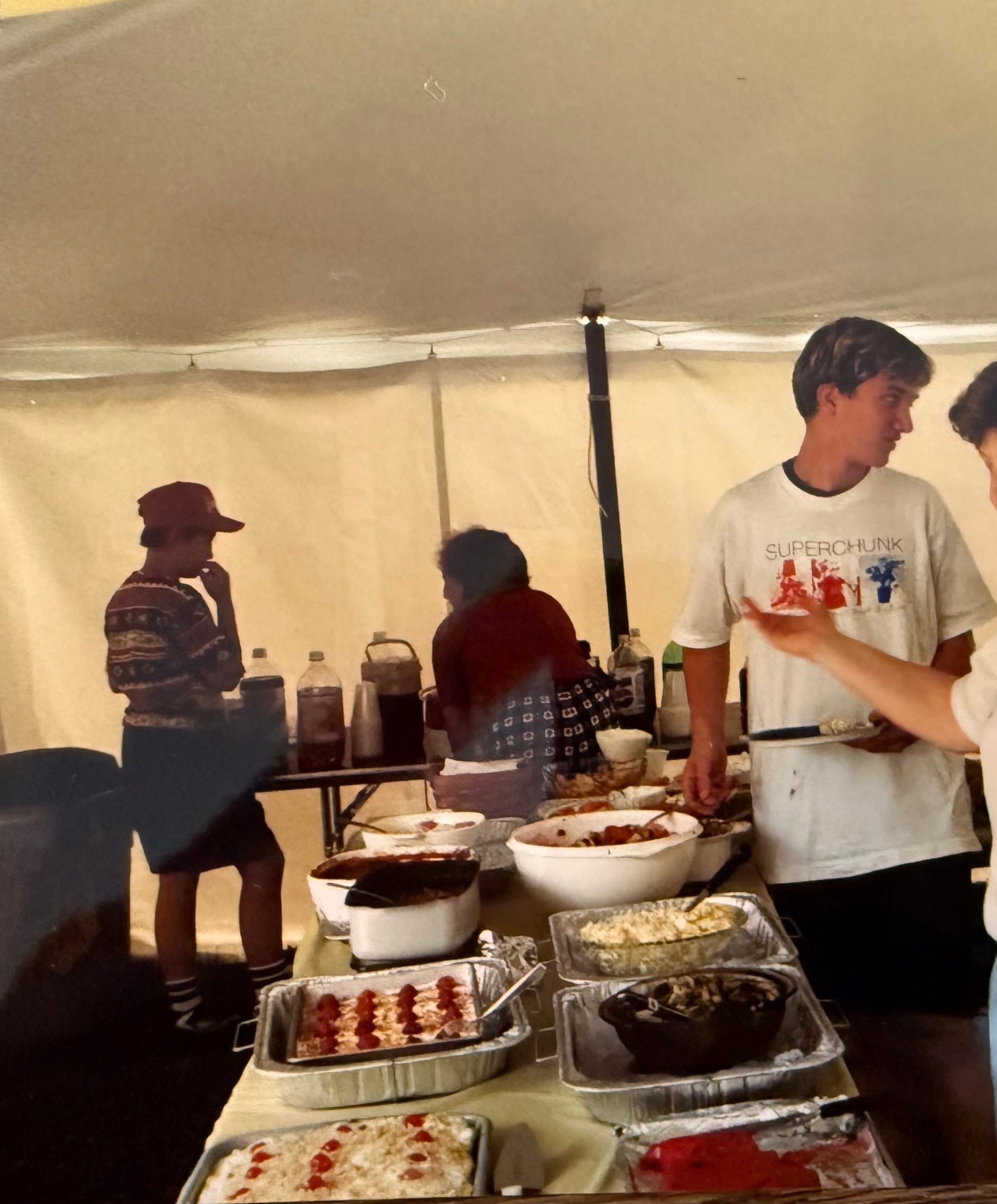
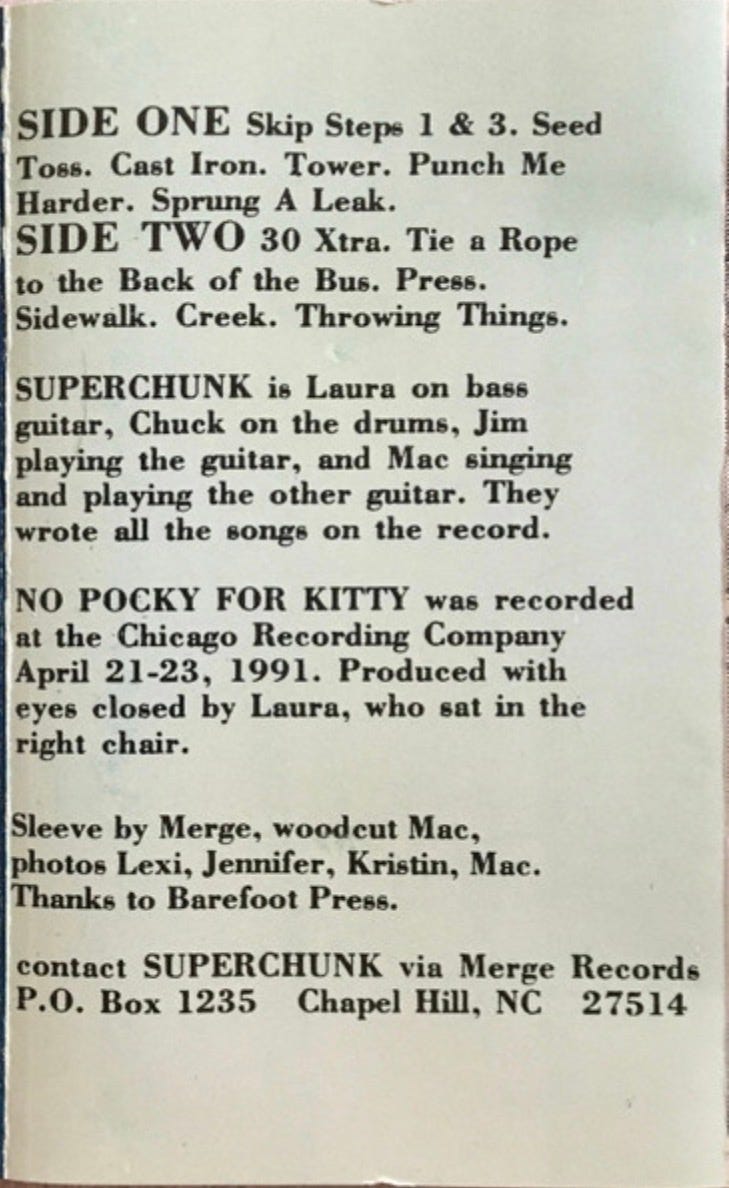
One thing I didn’t know at the time was that the person who recorded the record was Steve Albini. Although, to be fair to my younger self, his name didn’t even appear on the insert’s credits.
I didn’t know who Albini was yet. I learned that later, first through Shellac, and then, honestly, it took me the better part of a decade to fully connect the dots between musician and engineer. I’d see his name in the credits of records I loved and somehow thought of this as two different people. When it finally clicked, it made perfect sense. Of course, that heaviness, that weight, is him. I also felt like an idiot for not having realized it.
So, I like to think that I fell for this record on its own terms, knowing nothing, not even who the band was, other than its mention on another band’s insert. Maybe this is the best way to fall for anything.
For anyone who needs it, Albini is one of the foundational figures of American underground music. He was a musician in Big Black and Shellac, music and art writer and critic, scene creator, and the sound engineer behind a mountain of records that set the standard for what loud guitars and drums should sound like. He died in 2024, and it was like losing some of that foundation.
He recorded No Pocky the way he recorded most things: straight to tape and with the band playing together in a room. It took place over three overnight sessions in April at Chicago Recording Company, 6pm to 6am, about 36 hours all in, during a break in their tour. They cut it fast, and with the songs already worn in from the road, so the band was as tight as a band can get.
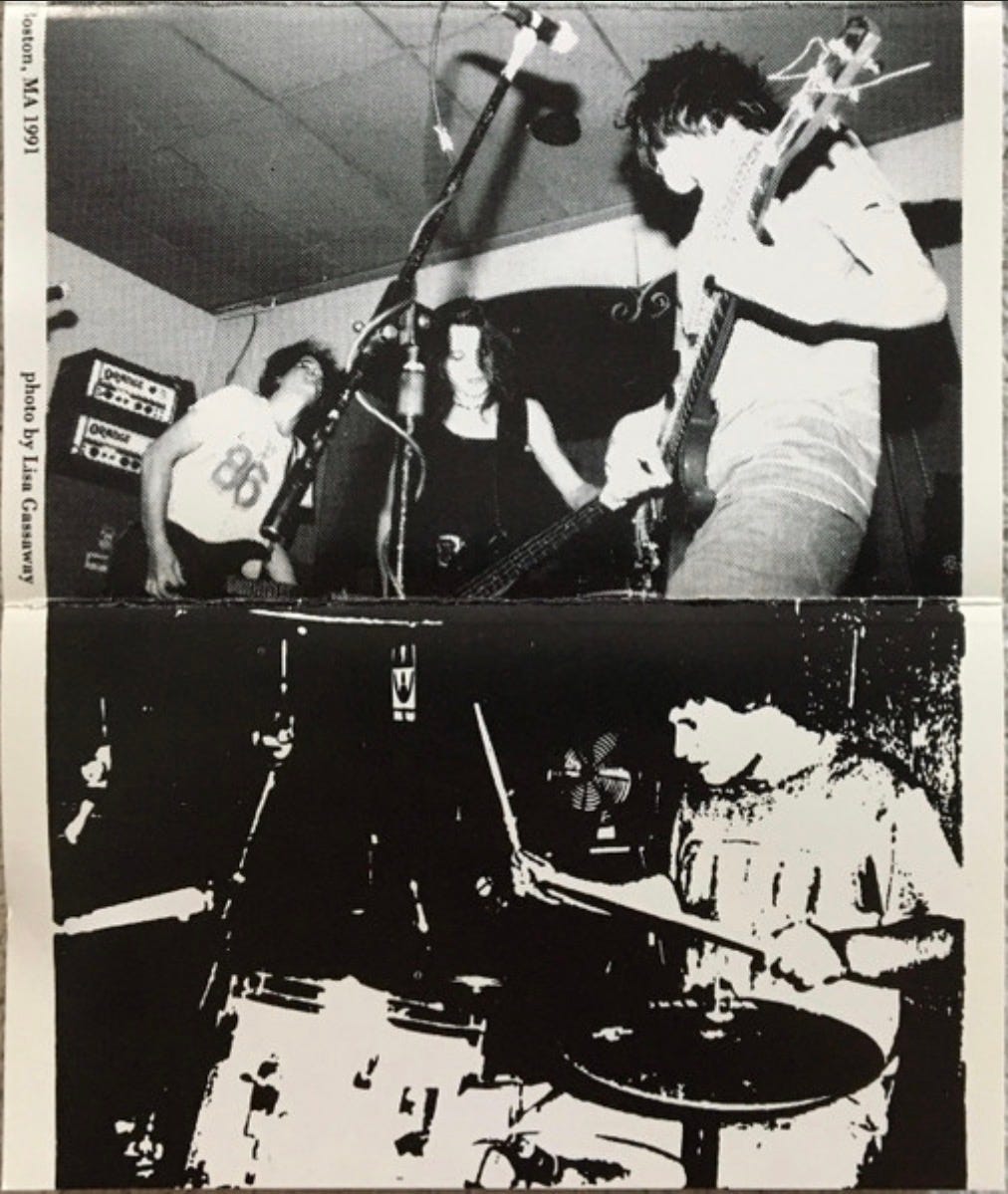
The best thing I’ve read about those sessions is from the guitarist, Jim Wilbur. Albini didn’t want to overdub or have extra guitar lines layered on. Every time Mac wanted to add a part, Wilbur remembers, Albini would just ask, “Why?” Because to him, the sound of the band was the sound of four people. Why would you want to do anything else?
That’s the idea around this record for me. There are no tricks. There are just four people in a room, caught at full speed. Mac McCaughan and Laura Ballance of Superchunk, later said that Albini made them sound “bigger than we were in real life,” which is exactly his engineering magic: a recording style built on keeping it simple, and yet the result is enormous.
To be honest, this wasn’t an easy pick. It wasn’t whether No Pocky belongs, but rather because Here’s Where the Strings Come In is also a fantastic record.
I’m picking No Pocky, however, because of what it captures. As I discussed above, this album captures a specific moment and version of Superchunk that they didn’t stay in for long.
I said earlier that they recorded this album fast and in the middle of tour. In addition to being a great recording story, it’s also the reason why this record sounds the way it does. It caught them at a particular week of their life, running at full speed, before anyone had time to think too hard about it.
That didn’t last, which is the other reason I chose it. From On the Mouth onward you start to hear the more considered version of Superchunk: cleaner guitars, more intentional singing, and a songwriterly turn (which eventually gives you Portastatic, Mac’s side project. There are a couple of tracks on this album that hint toward that, like “Throwing Things” and “Sidewalk.” But for the most part, No Pocky is from just before this, when the sound was still raw and half-formed, and the band was playing it hard so they could figure out what it was.
So, this pick is more a choice about which Superchunk I want to stay within, and for me, it’s the one that was still becoming. Perhaps, to be honest, it’s because I was still too.
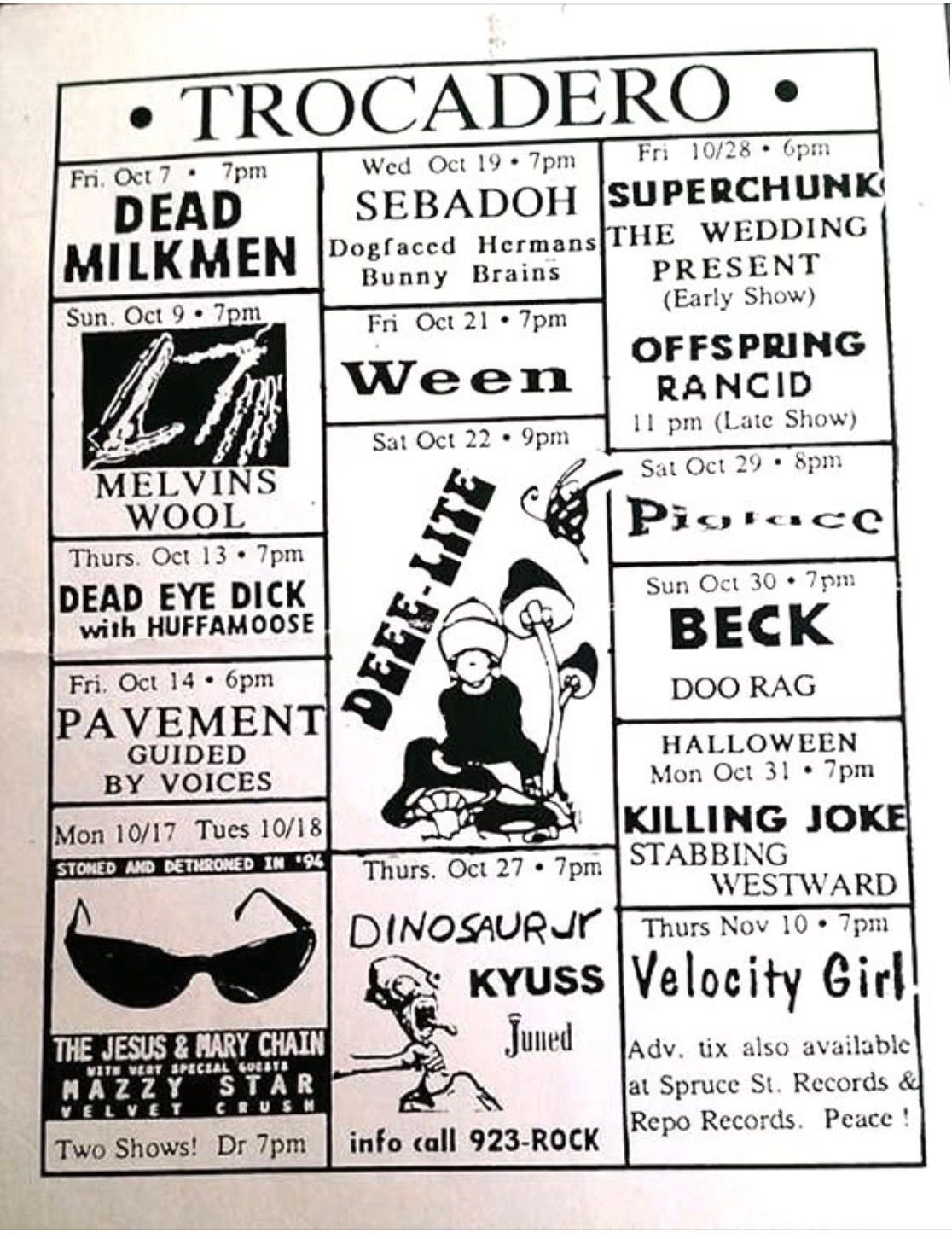
In October 1994, I saw them play live at the Trocadero in Philadelphia, and I was nervous.
I’d been going to shows for a while by then, but this was only the second one I’d been to at a big club. The first was also the Troc, where I saw Samiam and Bad Religion. And I was nervous for reasons unrelated to the band. I was 14 and couldn’t drive, so I was riding up with older kids from the scene, which, at that age, is its own kind of high-wire act. I was one month into high school, and these guys were seniors, and I think some had already graduated. I remember feeling excited because the older guys who took me up were also Superchunk fans and this was a band I loved and felt I found on my own rather than hearing from someone else in town. It made me feel validated in a way, and since I was heading up with them like I was in a cool membership club. But I was also nervous as hell. I had never really hung out with these guys on my own and I had to occupy the hour drive up and the wait before the bands played and not make a fool of myself and get kicked out of this “club” I now imagined myself part of.
The moment Superchunk started, all of that was gone. The nerves, the older kids, the being-out-of-my-depth. It just burned off in one ball of youthful abandon, and I was down there in the mosh pit, dancing and throwing myself around, and singing along. I remember them playing a lot off of No Pocky (or at least it felt like a lot), and each time it would fill me with more energy and excitement. Bouncing and singing along.
I remember the band’s looks of friendly amusement at me up from their spots on the stage. I’ve never been sure whether it was the way I was throwing myself around (“Are they surprised to see slam dancing?” I wondered) or the fact that I was so obviously a little kid who’d found his way into the room. Probably both. Well, probably the latter.
A record like this, however, doesn’t stop working when you grow up.
In 2007 I got back from a European tour. I’d been playing guitar with Dear Tonight, out with Boysetsfire on what was supposed to be their European farewell tour. Within a week of being back, I was at a mandatory, multi-day work retreat, one of those things at a retreat site in the woods of upstate New York in the summer. After a few weeks on the road with your best friends playing night after night (and even two shows in one night) over several weeks, the last place I wanted to be at was a work retreat. But luckily for me, one of my colleagues was my friend Clare, who had actually put out the recent Dear Tonight full-length on her label Red Leader Records, which she ran with her partner Matt. She offered a way of daily escape: we’d slip out to her minivan, drive off down the wooded roads, smoke cigarettes, and put this album on repeat. We both loved Superchunk. The two of us cruising nowhere in particular, windows down, with No Pocky for Kitty turned all the way up, letting it soar, wide grins on our faces.
Fourteen years after the Troc and the record did the exact same thing to a couple of adults that it had done to a 14-year-old in a pit. It doesn’t age. It just keeps going.
Not every great record needs to be a mystery or break you open. Sometimes the profound thing is just that it hits fast, makes you move, and keeps making you move for thirty years.
post-script:
Found this old letter from Jon with Superchunk in my files. I presume I was asking them about playing Delaware and something about Merge, apparently!
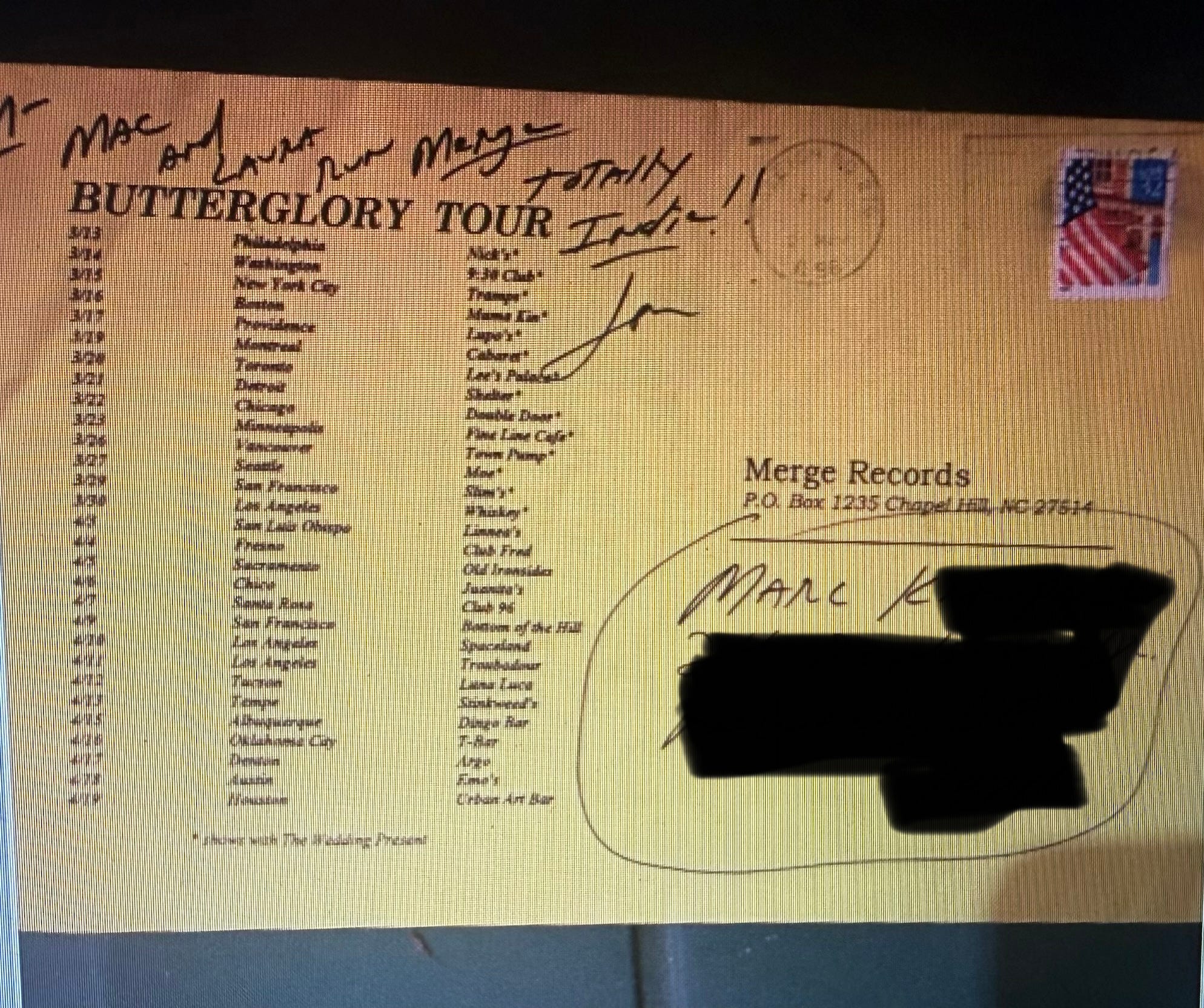
First of all, congrats on being the only 14 year old cool enough to realize Superchunk and The Wedding Present(!) would be a better show than the fucking Offspring. Speaking of The Wedding Present, Seamonsters is one of my favorite records Albini produced. And the song I always come back to from No Pocky for Kitty is “Cast Iron”.