
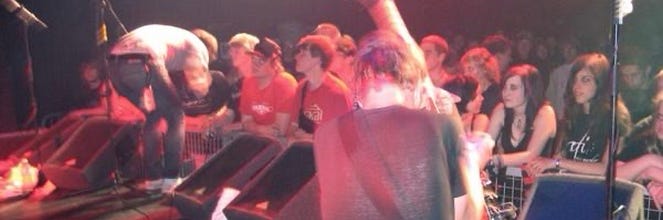
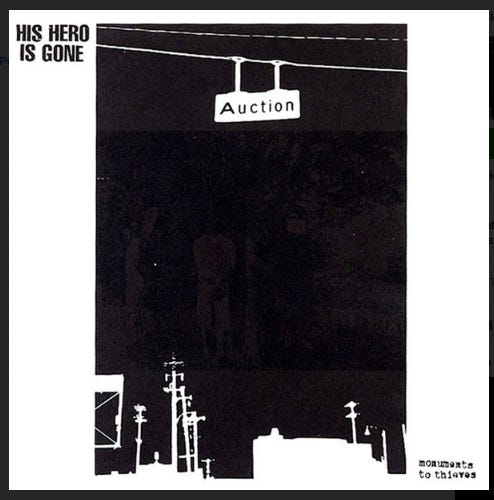
Album: Monuments to Thieves
Artist: His Hero Is Gone
Label: Prank Records (1997)
Runtime: 15 songs, 25 minutes
My seventh entry into the perfect punk album series, and definitely, the heaviest. After Superchunk and Jawbreaker, I thought it was good to swing in the other direction on the punk spectrum. Enter, His Hero is Gone.
His Hero is Gone had a 7” and a full-length plus some odds and ends by the time Monuments to Thieves was released in 1997. Launched in Late 1994 (according to a rare interview they gave to HeartattaCk, their first show was in November 1994) and breaking up in 1999, His Hero is Gone had already established themselves by this point, so chances are, if you put on this record, you knew what you were getting into. Still, even with this knowledge, it’s hard to be ready for what this album holds. Twenty-nine years on, and I still need to prepare myself when I press play. The album hits you like a sonic force field from the opening track all the way through its final, and 15th. 15 tracks. 25 minutes. It’s a 12” LP but played at 45rpm. It’s like you are being struck by a jet propulsion.
“Like Weeds” opens the album like the steep incline of a roller coaster. The metal screeches and lifts you upwards. Feedback, distortion, and sludge beats move the gears, while the eerily beautiful dueling guitar lines mark the ascent up the track. Almost like a funeral march. Making its way up the hill. Until suddenly, at 51 seconds in, you drop. Paul Burdette fires off a blistering drum fill, throttles into a blast beat mixed with syncopated accents, until 14 seconds later, you hear him do a three-count on his sticks and everything, both guitars and bass, launch in together on a ferocious d-beat. You’re propelled 120 miles per hour down the roller coaster track. Screaming. Smiling. Scared. Exhilarated. Holding on for the ride, and trusting that the orchestrators of this sonic roller coaster know what they’re doing and you’ll make it to the other side in one piece. You do. And before you know it, it’s over, and you’re back in line for more.
The songs across this album each land like this and in their own unique way. With an average length of 1m40s per track, the songs hit hard, hit fast, and hit heavy. They refuse to give you time to get bored, but more than that, the band uses brevity as discipline. They are fast and yet dynamic, with added syncopation and 1/8th time drops. So, while you’ll spend time screaming and finger-pointing along, you’ll then find yourself hurling your body with the breakdowns, your head swinging back and forth to the dirge or sludge beat.
The music is heavy, and while that term gets used a lot in musical criticism and description, this album really earns it. The heaviness is felt. From the D Standard tuning, to the thick distortion of the two guitars, the rumbling undertones of the bass, the kick-heavy d-beats and blast beats, the half-step chordal progressions, and of course the low growling of the vocals led by Todd Burdette (also on guitar) and Carl Augé (also on bass). It’s so uniformly heavy in fact that depending on the stereo and your presets, it can sometimes be hard to discern the timbre of each instrument and the variation within the songs. In my opinion, close surround sound, or live, of course, is best. In other words, the tone is low. But it works. They keep enough dynamism in the tracks and thoughtfulness in the melodic progressions that the whole album doesn’t simply become mud but stays fresh and frankly, interesting. That is a hard balance to maintain with this type of music. Indeed, even with the heaviness and the metal-tinged half-step intervals that give it that menacing trait, there is a clear melody across the songs. Okay, maybe you won’t be whistling them, but surely you’ll be air drumming while humming along.
This low-end, galloping, melodic dynamism that His Hero is Gone brought, and which is on sharp display in Monuments to Thieves, is what I think really sets this band apart from others that came before or who existed at the time. You hear this across many of its tracks, including “Chain of Command,” which plays more at a midtempo, anxious pace, the tension, heightened by the squelching high guitar note, tight across its 3:33 length (the longest track on the album by far, although to be fair, the last 25 seconds or so are a fadeout). Or on “Headless/Heartless,” which shows the melodic metal influence or “Hinges,” which has a hardcore punk d-beat drive.
His Hero is Gone comes from Memphis, Tennessee, a fact that takes shape across Todd’s lyrics. The title and second track of the album “Monument to Thieves” address this head-on, denouncing the statues of Confederate soldiers and the celebration of white lynch mobs. The anti-establishment aesthetic of crust punk takes on even more significance in the American South. While certainly not without meaning in London or the Lower East Side of Manhattan, where it was launched in the UK (with bands like Amebix and Antisect) and the U.S. (with Nausea), the subgenre’s countercultural abrasiveness is even starker in the South, including a blue city like Memphis. You see this in the lyrics to “Like Weeds,” where Todd growls, “Now, there is a war being waged: / It’s our words we must face / As our lives unfold and convictions are old / The real truth is told / And like weeds we will grow.”
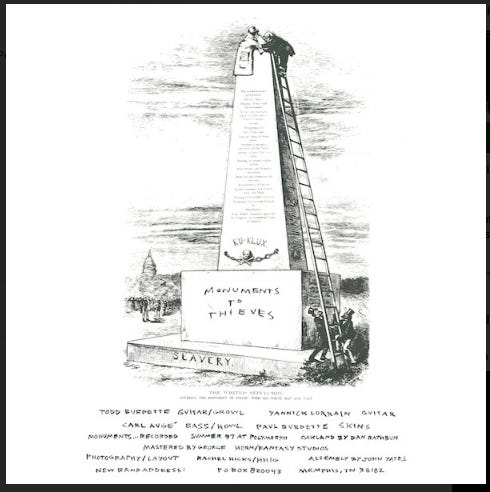
But it goes beyond the South to society as a whole. Alienation is a theme across nearly every song. Take, for instance, the shortest track, “Paranoia Secured,” which comes in at a blinking 21 seconds: “Do we feel safe yet? / With house alarms and car alarms / Secured paranoia with killer dogs and firearms / Locks on every door.”
The band avoided most interviews, so the record is relatively thin. But in that HeartattaCk interview I mentioned earlier, they discuss this further. They talk at length about their concerns about an even greater consumer society with the emergence of Internet-based shopping (this is early 1996), and they wouldn’t use computers even to produce their own artwork or lyric sheets (this sentiment takes shape in the lyrics on the album’s track, “Automation”). Todd mentions, passingly, that he made only $3,500 the previous year and lived in his van, but that he and the others were happy and content because they were doing things on their own terms and making their own path.
This album is an album of refusal. Refusal of polish, refusal of length, refusal of melodic accessibility (my previous comments notwithstanding), refusal of status (they gave nearly no interviews), and refusal of societal status quo.
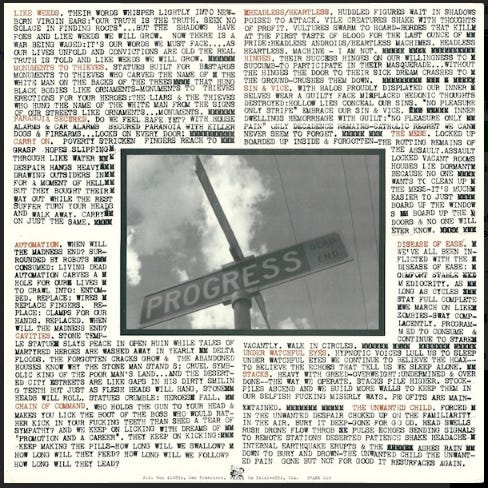
I said from the outset of this blog that I use the term “punk” broadly to encompass all the variations of sound and style in this music. At its heart, it’s always just punk to me. But since I just wrote a piece exploring emo, I can’t talk about His Hero is Gone without saying more about crust punk, at least for the uninitiated.
Crust punk emerged in the mid 1980s in England as a fusion of sounds and politics. It brought punk (the anarcho-punk end) and metal (the extreme metal end, like thrash and doom) together with an explicitly anti-establishment, anarchist politics. Angry, growling, fast with sludge parts, and heavy. The subgenre has Crass and Discharge as its spiritual godparents, from which everything else has flowed. It is not just the sound and politics that define crust punk; they extend to an aesthetic, if not an ethos, and a way of life. Bands were typically named something jarring or caustic-sounding (see the aforementioned bands, as well as Doom, Extreme Noise Terror, Choking Victim, Dissucks, or Das Plague). Nearly every band name is written in illegible lettering, whether spiky metal-influenced font, degraded xerox style, or hand-drawn brush. You could spot (and sorry, yes, sometimes smell) a crust punk a couple of blocks down the road. The uniform of dark and army green colored clothing, often tank tops and long shorts, with more patches than you could recognize. Couple this with dreadlocks and facial piercings, and scruffy facial hair for the guys that somehow, often enough, were never fully grown in.
I never jumped in myself. Maybe in part because I was straight edge at the time (I feel like I never saw a crust punk kid without a 40, even though some were reportedly straight edge), but also because I could never fully commit to such a statement of social rejection. Still, a few friends were crust punks, especially because they were reliably present at protests and politically aware activists within the punk scene. Most of them were anarchists, feminists, vegetarians; they were the most visible punk kids you’d see at protests. And despite the seriousness or anti-social demeanor the aesthetic could give off, I always found most crust punks not to take themselves that seriously (indeed having a silly side) and have a sense of humor.
His Hero is Gone is one of the most well-known and popular crust punk bands. Distinct from the initial waves from the mid-‘80s, and perfecting their own unique sound with the melodic undertones that give shape and texture to their D (or in other albums C#) tuning, distortion, and howls.
Three of the four members carried this sensibility when they went on to form the band Tragedy (you can hear early hints of Tragedy on the track “Chain of Command”). I actually wanted to include Tragedy in this series, but sadly, I don’t think any of their records pass the test (maybe I’ll include them in a future honorable mention). I was lucky enough to play a show with them at ABC No Rio (a perfect setting) and was just awed by the fullness of their guitars. A sound I hunted after (and desperately tried to replicate in Dear Tonight’s song, “Dead Boys”) but without success.
But before Tragedy, I got to see His Hero is Gone live several times. I remember seeing them at the DIY-punk warehouse space, Stalag 13 in Philadelphia (again, a classic setting for such a band), among other venues. My most memorable is when I saw them in Chicago at the Fireside Bowl in the summer of 1997. They played with Los Crudos, a legendary hardcore band of all-Latino guys based in Chicago and fronted by an out queer singer who screamed entirely in Spanish. As a result, I’ve always associated the two bands together. If I remember correctly, it was a matinee. I was on a cross-country road trip with three friends, Meatball Matt, Casey, and Donna. Ostensibly, we were driving Casey to college out in California. More so, we were taking a few weeks before our senior year in high school to track across the country and back, sleeping on floors and couches of pen pals we made through the mid-90s DIY punk scene.
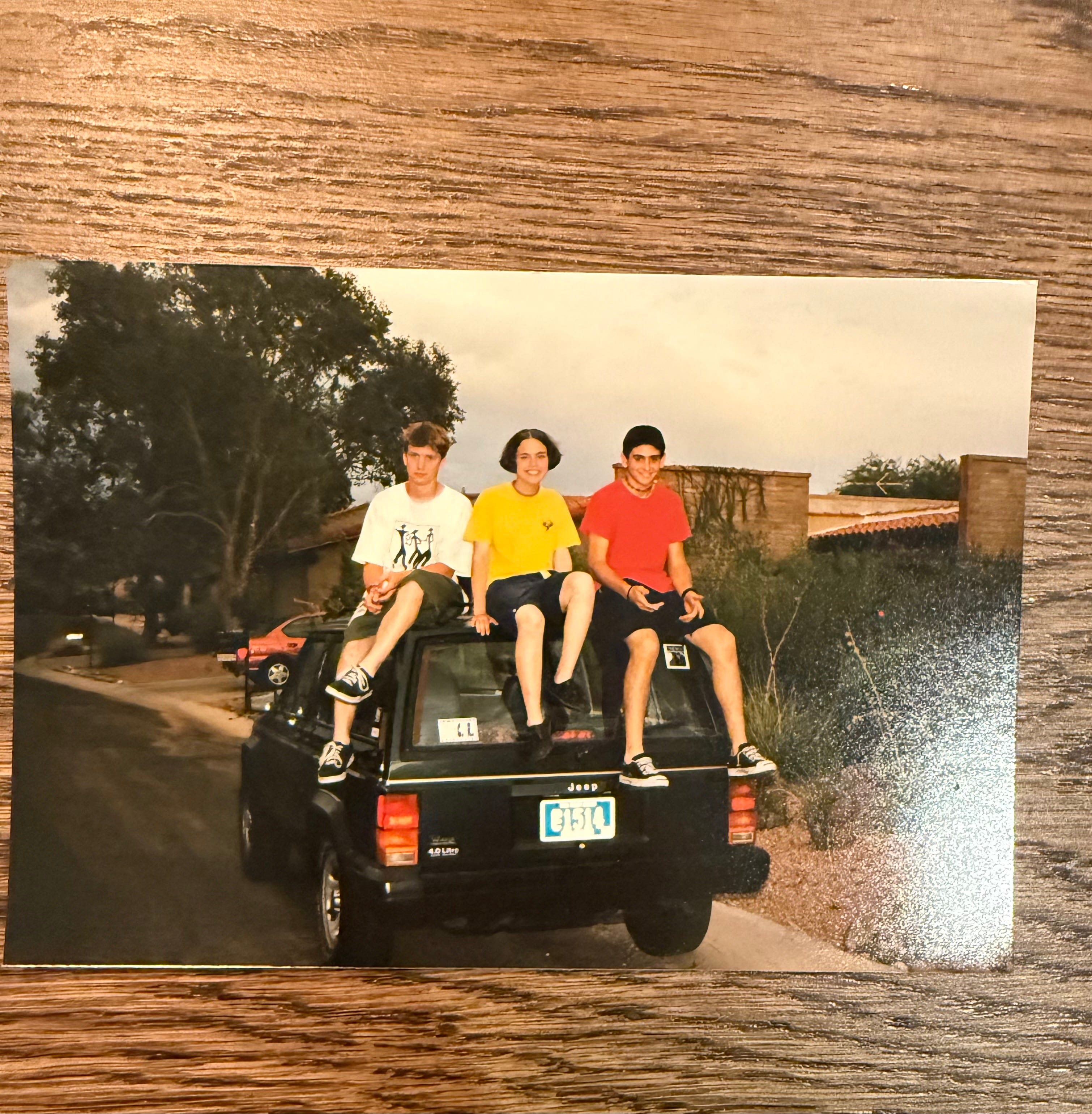
This was one of the beautiful things about the scene at the time. We developed such close relationships with people that we would meet at a festival somewhere, or maybe they put out a zine you read, or played in a band you put on a show for, or the opposite way around, and we’d just write each other. I remember the letters would vary in length. Sometimes just quick matter-of-fact updates, but often more than that, little tidbits of our lives, music we were listening to, or often sharing poetry, writing, art, craft, mixtapes, or more. And always with that “p.s., reuse the stamp.” (There used to be a thing that if you rubbed a thin layer of Elmer’s glue over the stamp before you mailed it, then when the other person got your letter, they could wash off the postal stamp ink and cut out and reuse the stamp. It actually worked).
We tapped into it for this trip, staying on friends’ couches in Chicago, San Francisco, San Diego, Little Rock, Plano, and more. We camped out one night off some random road north of Denver. We lived off peanut butter sandwiches.
This was pre-Google Maps, pre-MapQuest, and even pre-commercial GPS days. I remember going to AAA and meeting with someone who helped us highlight a route on our giant road atlas. It was an adventure.
So in Chicago we stayed for a couple of nights with my friend Laurent, whom I met through my old girl/friend Cristina, and on the floor of one of the Braid guy’s apartments (can’t remember if it was Chris or Bob - we had set up several shows for them in Delaware by this point). I remember one night, sitting on an El train overpass with Laurent. Taking in all the sounds. We were both straight edge at this point, so no Mad Dog 20/20 this time (see my previous Jawbreaker post), but instead long conversations with the rumbling trains underneath us. Talking about politics, music, Faith, the future, and moving past my teenage crush.
The next day we went to this show. I think it may have been the only show we saw on the whole trip. We had timed our Chicago stay for this show (we stayed there a few nights, which was the longest we stayed anywhere on that trip), and it did not disappoint. His Hero Is Gone was touring in support of this album. For whatever reason, maybe because it was a matinee, the show wasn’t packed. It’s a shame because it was one of the best and most fun shows I’ve ever been to. First, being at this legendary punk venue, which was also a bowling alley. Second, getting to see Los Crudos live in their hometown (I still have their shirt and record I bought there). They were amazing. Martin is such a great frontman. And third, His Hero is Gone playing much of this album. I had their 7” and first LP at this point, but this was the first time I was hearing this new stuff, and it just blew me away. I thought I knew hardcore before, but their set brought it to a different level.
The magic of the DIY punk community, I think, is what, in large part, makes this show so memorable. Here we were. Seeing a band from Memphis that gave almost no interviews, wouldn’t touch a computer, did everything on their own terms, and made a 15-song record that lasts twenty-five minutes. And nonetheless, it still reached four kids on the road from Delaware in a bowling alley in Chicago. It came through word of mouth show advertising, sleeping on a friend’s floor, a stamp someone washed and reused, shows and zines we put on and out ourselves, and a route highlighted by hand at an AAA desk. They refused every mainstream channel that was supposed to carry music to people. It reached us anyway, because the community was the channel.
We got the record and quickly dubbed it to cassette so we could listen to it in the car (which only had a cassette deck!). We played it on repeat as we headed out of Chicago, energizing us across the long, flat, and empty roads awaiting us further west.
Great post, and a great record.
I got a chance to see HHIG a bunch of times, but the most memorable was their infamous show at Epicenter, the SF collective punk rock record store where some crusty hung from a water pipe, which burst, flooding the building, closing the store, and all but ending the place. Good times.