

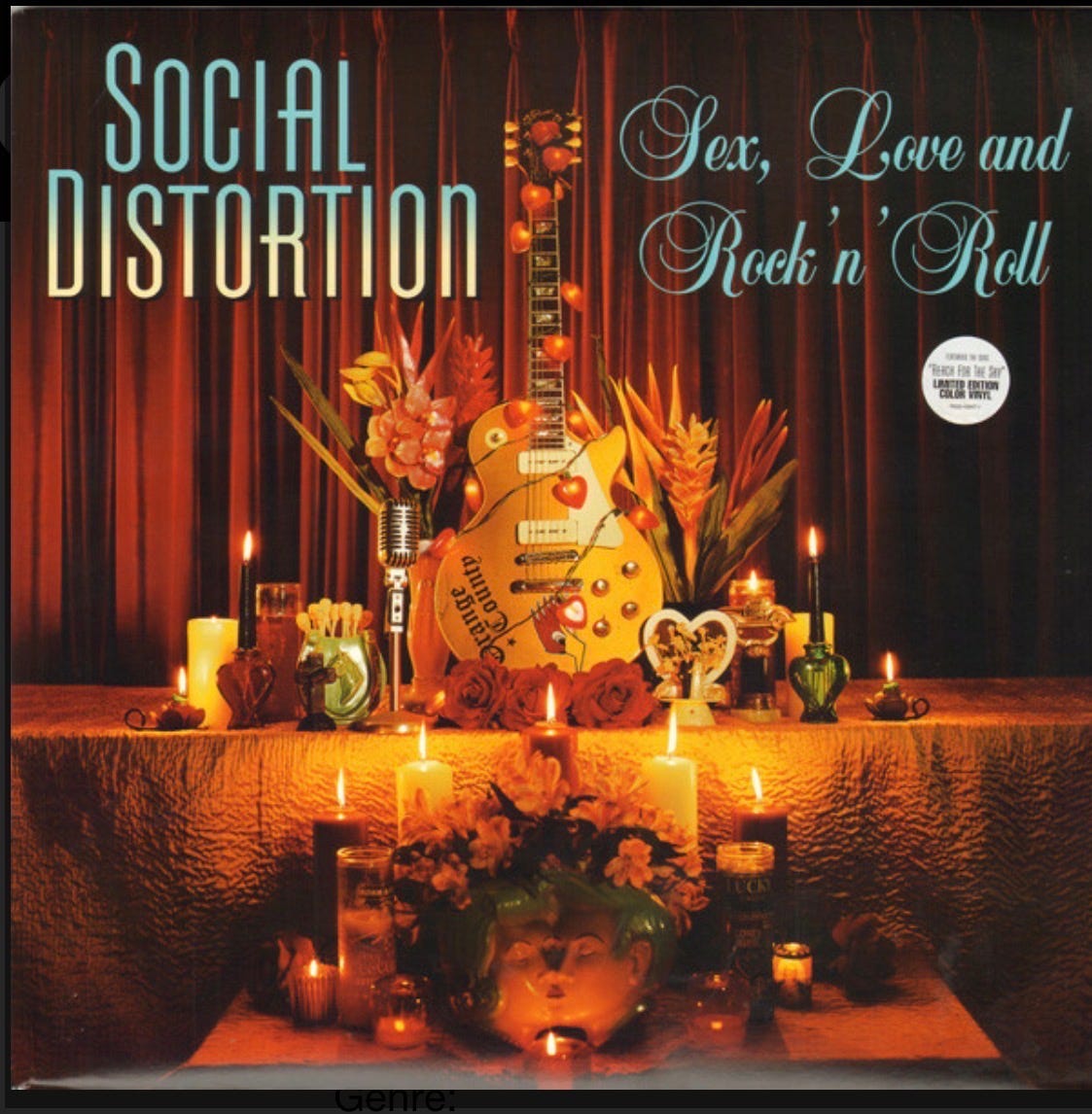
Album: Sex, Love and Rock ‘n’ Roll
Artist: Social Distortion
Label: Time Bomb Recordings (2004)
Runtime: 10 songs, ~38 minutes
This band doesn’t need much of an introduction, and this record likely doesn’t either. Eighth entry in and my first one outside the 1990s. (When I started drafting this piece, I went on a long sidetrack about why that may be, but pulled it from here to save for its own dedicated post. Stay tuned for that). So, if I’m gonna do a record from the 2000s, what better way to start than one put out by a band that formed in the…1970s.
Sex, Love and Rock ‘n’ Roll is the sixth studio album by Social Distortion and was released in 2004. The band was a well-known entity by this point, having formed in 1978 out of the Orange County/SoCal hardcore scene of the late ‘70s. Over the next two decades before this record, they took on slightly different variations in sound and lineup and had several hiatuses due to drug rehab stints. But they were a legitimate big punk band nonetheless. Within their first five albums they secured a certified gold record, landed in the Billboard 200, and most people point to one of these first five, rather than this one, as their best. But to me, this is both a perfect punk album, and, their best.
My test for this series is an album that has no skippable song. This isn’t simply an album with no skippable track; it’s an album filled with hit after hit after hit. Each time I listen to this album, I get excited when the next song comes on. I think to myself “oh my gosh this is such a good song” and get kinda sad when it ends only to find that excitement ratchet back up even higher with the opening notes or beats of the next song. In other words, each song is a damn great song. Two or three would make any album and on this one, it has ten of them, one right after each other. They’re also arranged in such a way that they flow organically together. If I drew up a set list for a late summer outdoor festival set list, it would be exactly how these songs are arranged. Perfect. Let’s talk about them.
It has one of the best songs to kick off an album and one of the greatest verses to set an album’s emotional tone with “Reach for the Sky.” The song erupts with a quick squelch of feedback, the brief bursting yelp of a kettle hitting its boiling point and shooting off hot steam. Musically, the song starts with a rising progressional prelude, followed by a rollicking guitar lick, all underwritten by a driving upbeat punk beat. It’s an aggressive melodiousness. It’s riding down the road, 80 miles an hour, with the top down, straight into the sun. Mike Ness, the frontman and creative force behind the band, then sets the tone with the opening verse: “When I was young I was invincible / I find myself now thinking twice / I never thought about no future / It’s just the roll of the dice / But the day may come when you’ve got something to lose / And just when you think you’re done paying dues / And you say to yourself, “Dear God, what have I done?” / And hope it’s not too late ‘cause tomorrow may never come.”
Damn. Talk about a wake up call. Ness throws down the gauntlet. The song, the album, is a reckoning. It comes from someone with well-known and documented struggles over the two decades the band had been together at this point. He’s not shying away from where he’s been, he’s not pulling any punches. He’s looking straight into the mirror and saying it’s time for an intervention, a course correction for a different, better path forward.
The guitars chug, the drums drive, and the vocal melodies are delivered in perfect sing-along fashion, including with background ahhs.
The next track, “Highway 101,” drops in before “Reach for the Sky” fully rings out. A rockin’ drumbeat on kick bass and snare. It’s a beat that could’ve emerged from any great ‘50s or early ‘60s rock ‘n’roll or r&b song and then is met by Ness, squealing feedback and guitar licks. Then the guitars drop in with their head bobbing rhythm, mirroring the drumbeat by playing the chords on the kick and palm mute harmonics on the snare. It exudes a self-sure confidence. It’s a song filled with hope. A song where you’ve seen your share of knockdowns and setbacks but right now, in this moment, everything is right, and the future is filled with promise.
This song, this album, has California written all over it. And as a punk kid born and raised on the East Coast, to me this is my Beach Boys California anthem song and album. Maybe it’s fantasy, but I don’t think so. Each time I’m in California and driving a car (which is every time I’m there), I put this album on and it fits just right. This song most especially.
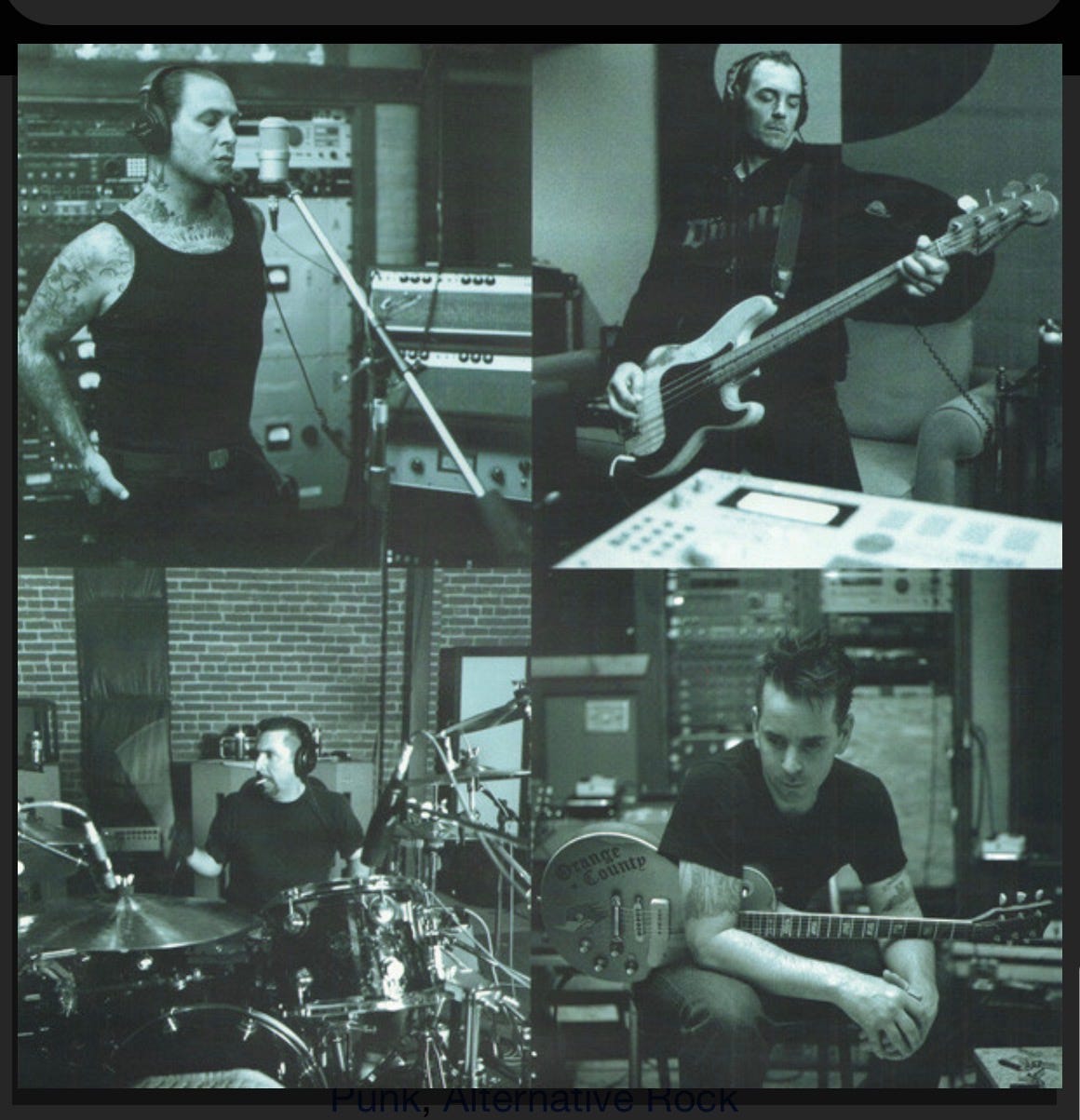
I can write an ode to each song on this album. They are really that good. The circle pit start of “I Wasn’t Born to Follow.” A song perfect for setting our own path on the side of the underdogs. The laidback strutting vibe of “Footprints on my Ceiling,” which also features a superbly placed Hammond B3 organ at the intro and over the chorus. (The Hammond B3 has unique features that make it similar to a pipe organ rather than a piano or synthesizer. When you press the key of a Hammond the sound of the note releases at a continuous volume until you let go of the key, rather than a piano whose volume gradually decays. It also features vibrato, which wobbles the pitch up and down as the note sustains, and chorus, which blends the note with a detuned twin. It’s a full sound and one that complements the energy and volume of Social D perfectly rather than fighting or taking away from it.) The organ comes back In “Winners and Losers, “Faithless,” and “Angel’s Wings.” I especially love it in “Faithless” where it announces the intro and turnaround as its vibrato and chorus effects give it a ripe fullness that grabs your attention and gives you energy.
And then, there’s “Don’t Take Me for Granted.” To talk about this song, to talk about this album, to talk about this band, in fact, I have to talk about my brother, Matt.
I can’t think of Social Distortion without thinking of my brother, Matt. It’s impossible to do so. I wrote about Matt in a couple previous posts and I’m sure I will again. As I talked about before, our lives were defined by music, as was our life together. He died, unexpectedly, this past March. And he loved Social Distortion. It always surprised me that he did, to be honest. He was generally into heavy stuff. Music with oomph, thick rhythm sections marked by syncopated beats, bluesy bass lines, heavy breakdowns. He especially loved the hardcore end of the spectrum. Bands like Snapcase, Sick of it All, Deftones, Quicksand, Helmet, and some post-hardcore bands like Jawbox. Led Zeppelin and John Bonham’s drumming were the foundation upon which he built his musical life and journey. He was generally dismissive of the more melodic punk that I was into growing up (along with the screamy stuff). Bands like Superchunk, Jawbreaker, certainly the poppier stuff like Screeching Weasel or Propagandhi. And to me, Social Distortion leaned more to this side musically. Don’t get me wrong, I’m not calling them pop-punk at all, but there is a more straightforward four chord melody to their songs. Most of the songs are upbeat without the moshing, floor punching, breakdown parts. It’s not hardcore. It’s punk rock. But he loved it. And I think a big reason is that there is a bluesy toughness to their music and to this album. And most certainly, to the lyrics themselves. Mike Ness is the quintessential blues-rock ‘n’ roll punk rocker. He’s got the look, the voice, the credibility, and most certainly, the steely resignation of a hard lived life, but one that still grasps onto hope and self-deprecative humor. I think Matt took solace in that. He found affinity in it. I think it spoke to his own pains, his own struggles, and really, his own hopes in a way he just couldn’t locate and express on his own. Matt found himself knocked down often, but he would always manage to pick himself back up and push through even stronger. He would struggle with putting all this into words at times. I think Social Distortion captured it for him in many ways. And quite frankly, it’s just good music. And the optimism within both the harmonic structures and lyrics make the music, well, fun. After he died and I was sorting through his belongings, the only t-shirt of his that I kept for myself was his Social Distortion shirt.
I can’t hear this album without thinking of all the summer nights, arm in arm with Matt, in some field, on some stage, at some festival in Europe, listening to and singing along at the top of our lungs, stupidly drunk and happy, to Social D. In the 2000s, Boysetsfire toured Europe often and was on the festival circuit every summer, sometimes twice a summer. And it seemed, on at least two-thirds of those, there was Social Distortion playing as well. From 2003-on, I was on a number of these, so we got to hear this album performed live nightly a lot.
So, to me, this album is the sound of summer. It’s the sound of hopeful abandon. It’s the sound of getting knocked down but laughing at the situation and yourself, and then picking yourself back up because you know there is more ahead, and one of these days it’s going to be good, real good, damnit. It’s the sound of brotherhood. It’s the sound of family.
And now, this album is the sound of something else for me as well. Something else I’m still trying to make sense of since Matt died.
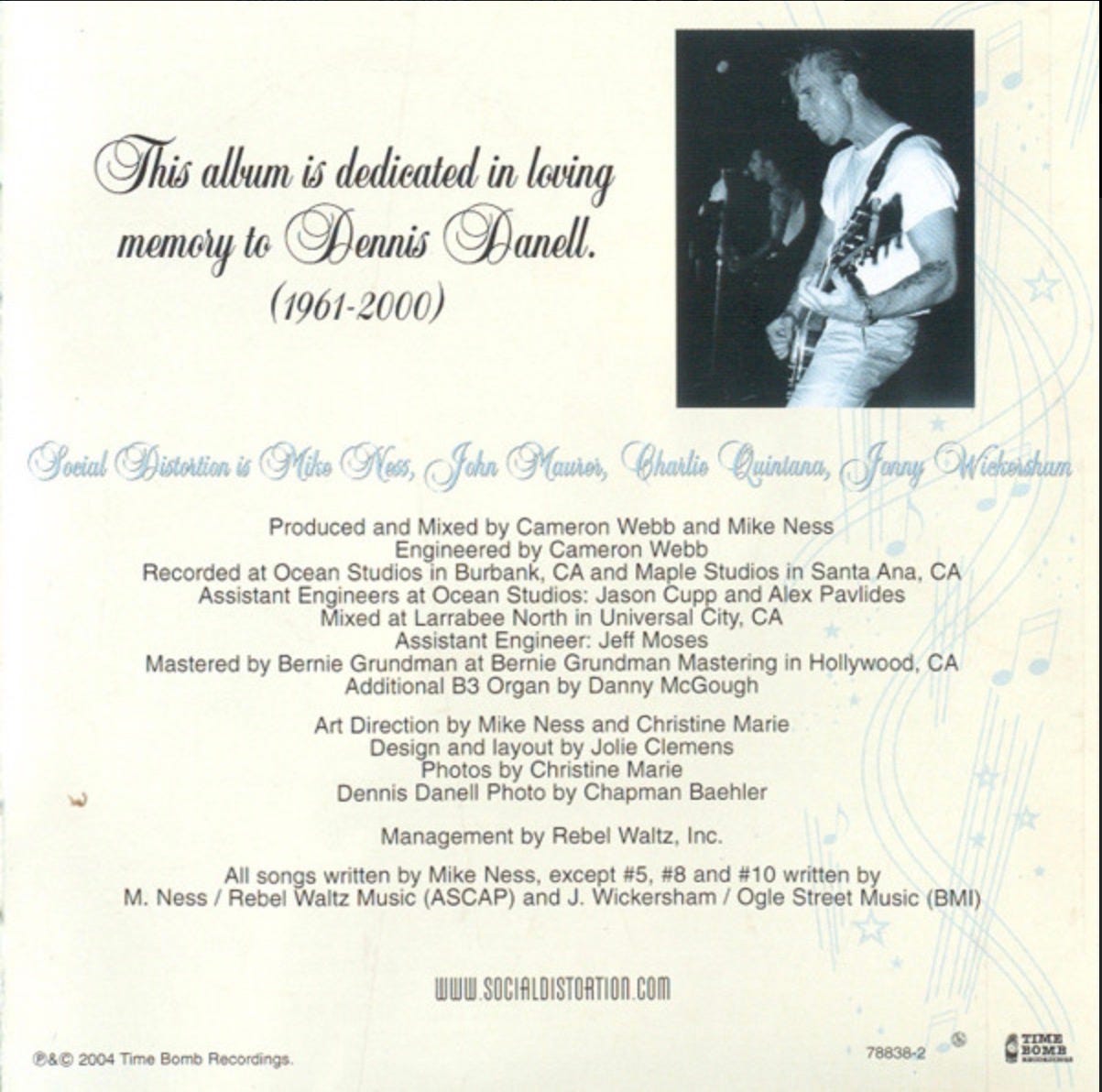
I’m likely embarrassing myself by this, but I didn’t know the full story behind this album until I started to prepare to write about it for this blog a couple months ago. I always just took it for what it immediately put out, which for me, was enough. But what I learned was that the release of Sex, Love and Rock ‘n’ Roll in 2004 marked eight years since Social D’s previous record. The delay was due to the untimely death of founding member and guitarist, Dennis Danell in February 2000. Danell died in the driveway of his new home while moving in with his wife and two young children. It’s reported he died from a brain aneurysm. He was 38.
The plan had been for Social Distortion to return to the studio at some point in 2001. Their last album came out in ‘96. Ness had taken a brief break, in part, to work on his solo project. But after Danell died, he found it hard to put the pieces of the band back together. Dennis was his lifelong friend who he recruited to join the band. Even teaching him how to play guitar so he could play that instead of bass for Social D. In fact, two of the members at the time quit rather than wait the two years for him to learn how to play. As Mike said at the time of his death, “I am saddened beyond any possible form of expression. Dennis and I have been friends since boyhood, starting Social Distortion while we were in high school.” It left Ness as the sole founding member still in the band. As a result, his death and Ness’s reaction to it, his processing of it, found its way into many of the songs across the album. Four years after his death, and eight years since their last album, this record was released. It’s dedicated to Danell.
It’s a strange experience revisiting this album knowing all this context after my brother died. It’s strange how grief, or to be more precise, death, changes everything. I was talking with some friends about how strange of a thing surviving the death of someone close to you is. Someone that you grew up with, that has been such a key piece of your identity. It’s something that comes for us all yet we rarely talk about. It’s strange how the world keeps moving. It’s strange how we must keep doing all the mundane things: filing our taxes, cutting our grass, buying groceries. It’s strange, especially when the death is sudden, unexpected, how everything was moving forward. The timeline was ticking ahead. And then, all of a sudden, it just stops. Abruptly. That’s it. That’s the end of their story.
Now, I’m sure that isn’t. I know, depending on time, mood, perspective, I can see the ways in which the story continues. The legacy. The impact on others. How that person’s death and their life continue to shape you and others. How there can even be a promise of an afterlife. I know. But what startles me the most is the finality. The period at the end of the sentence. That’s it.
And so with all this, this album hits differently. I can’t help but absorb it through the loss of my brother, and all the memories I have of listening to this album with him, both live and recorded, and think about how it was written in a similar aftermath of sudden loss of someone close and the grief associated with that. The songs, their lyrics and sonic textures, come into a sharper relief. The ache and the longing are carved deeper. And the optimism and hope rise higher.
Because that’s the thing about this record. To me, it captures the essence of Social Distortion at its finest. And what this band is, is both of these. The getting knocked down but knowing, or more accurately still believing, the sun is coming back up tomorrow and we’ll have another chance to get it right, finally, and for once. Maybe this could only emerge from everything that happened. Maybe it was because Ness was venturing into a solo project when suddenly, he was the last original member of his band of (at that time) 22 years. The personal writing he’d gone solo to do ended up coming back into the band. And by then the band was something different. Social Distortion started in 1978 as a group of friends. Now the only one left from that was Mike Ness. The other guys had earned their spots, no question. But they joined a thing he and Dennis had built. I wonder how much this is a lonely position, rather than one of, say, seniority. To be the last standing. Whatever Social Distortion meant, it now meant him. You see this embodied in the album’s cover, Ness’s guitar place on an altar as an offering.
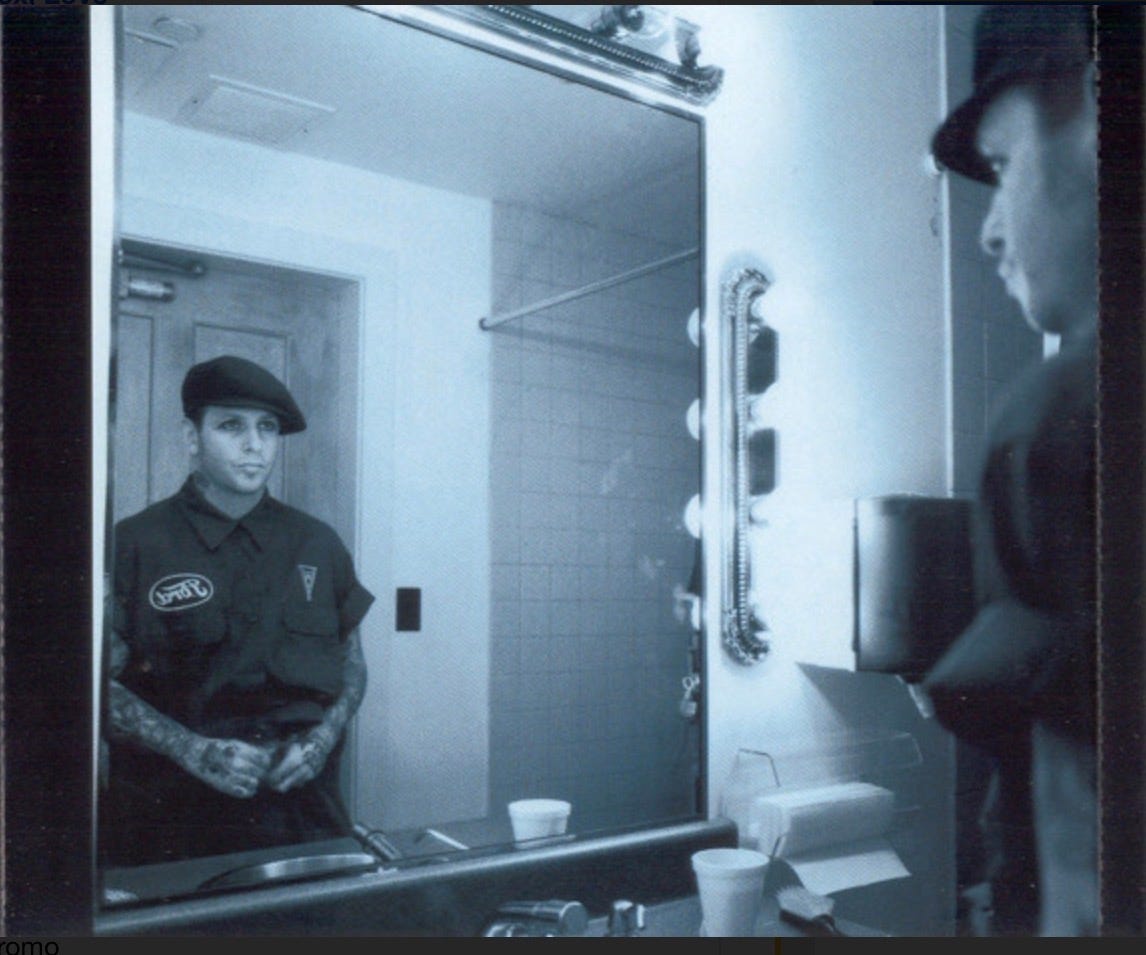
Ness, as Social Distortion, was still writing, still singing, still playing through and despite the hardships. The turns with addiction and rehab. The struggling to make it not just as a band but financially. The departure of bandmates. The death of a childhood friend. Or maybe in all actuality he was doing all this not despite these things but because of all of them. And now, from that, here emerges a perfect record. It reminds me in some ways of many mystical experiences with God and life: the idea that we are made more perfect through our suffering. This allows us, in turn, to more fully experience and embrace the good in life because of the empathy gained from suffering. This is achieved not by repressing them or fighting them, but by facing them head on, just like Ness calls out in his opening verse, and reach for the sky.
And this brings me back to “Don’t Take Me for Granted.” While the whole album has Dennis’s death written across it, this song is the one most identified with him and written most especially for him.
I came across a video of a live performance of the song from over 20 years ago. Ness introduces it and dedicates it to Dennis. He talks about how Danell was a great friend and the moral support of the band that everyone leaned on. “It makes you think that your friends and loved ones are gonna be there forever and then one minute they’re gone forever.” He then introduces the song title and they launch into it. You can watch it yourself here.
Because this is the message within this album. It doesn’t shy away from life’s bruises, its pains, its utter heartbreak. It sees all of it. And it says, yes, all of that is true, and still, things will get better, tomorrow’s sun will be there, life is good, go live it.
The album ends on two songs that embrace this most fully, “Live Before You Die” and “Angel’s Wings.” From the first: “So close your eyes and embrace your memories (your memories) / Leave your troubles and your worries far behind (so far behind) / Stop contemplating, start celebrating / Yeah, you'll live before you die.”
And from the second: “And when you're down on your luck / Hey baby It's a long, long way up / Hold back now, hold back your fears / And when you're really down and out / And you feel like there's no way out now / Let go now, let go of your tears some more.” “Tired of figuring out things on my own / Angel's wings, won't you carry me home.”
Amen.
❤️