

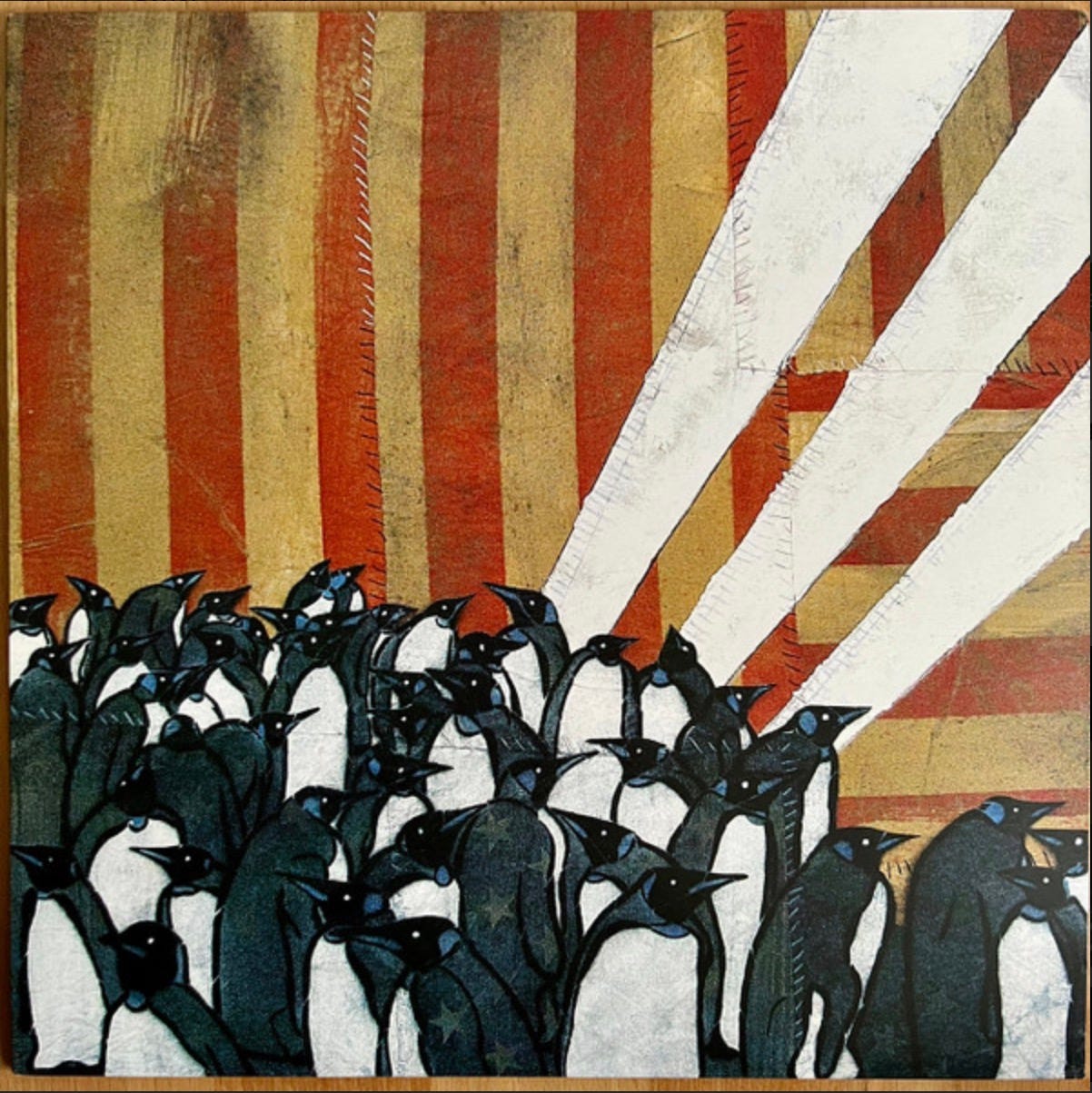
Album: C I V I L W a R
Artist: Dillinger Four
Label: Fat Wreck Chords (2008)
Runtime: 13 songs, ~ 39 minutes
Back to perfect punk album time. This here is the 9th entry in the series. And my second one outside the 1990s [By the way, since I’ve launched this blog in late June, I’ve been running at a post a week. I’d love to keep this going, but it’s a pace that I know, sooner or later, is gonna run me out. I don’t know when. Next week. Next month. Will it be a tree falling in the forest? Will anyone notice? Who knows.]
But I’m here to talk perfect punk albums. This one, I’m intending to give straight: Dillinger Four’s Civil War. What do I mean by doing it straight? Well, I’m not sure I have a real personal tie to this record or this band, other than that it just being damn good. I don’t know the guys in the band. Never played a show with them. Heck, never even seen them live. Surprisingly perhaps, because they are a heavyweight, but never did. Maybe because they were most active in the 2000s, which, while I was playing regularly with Dear Tonight and then Young Lady, and doing some tours with Boysetsfire, I don’t honestly remember going to a lot of other shows at this point in my life. Maybe it’s because I was also working full-time and busy with volunteer political organizing, with meetings or projects multiple times a week. But it was also a period of my life where I felt, well, burned out. Is that a strange thing to say, to experience? Being burned out in your 20s? That’s supposed to be the time when you are soaring high and running 100 miles an hour. I mean, I was doing a lot, but that may have been what it was. I was just drained and didn’t realize it. Drinking, drugs, and romances served as a form of self-medication, but each ultimately just left me feeling emptier. To some degree, being in my 20s, working a political job, playing and touring in bands, and doing activism all while in New York City was just, well, a lot. So, anyway, I don’t really remember going to shows all that much, at least when I wasn’t playing them. Maybe that’s why I never saw Dillinger Four. But it may also be the simple fact that I didn’t really dig into them, and this album in particular, until about a decade or so after it got released. It’s funny, the way sometimes albums play out like this. I heard singles and certain tracks, but never fully sat and listened to the album until maybe around 2019 or so, and started listening to it while going on runs. Maybe, and quite likely, I had fallen prey to the streaming demon. I was fed single tracks, and I’d put them on playlists or just bought those one or two songs and never really digested and sat with an album. That was especially true of much new music during the 2000s. Maybe that’s another reason for my 1990s bias (see my last post): simply that I know those albums much better than the ones that came after. Could be. Whatever the reason, this album for me is just, well, the album. No relationship, no girl, no friend, no brother, no coming of age, nothing. It’s just an album that’s perfect.
But there I went. Said I had no personal connection to this album and then went on an inner monologue about why that could be. I swear this is not just for myself. I have to believe I’m not alone in these experiences. Is this thing on? Is anyone out there?
It is surprising to me that this is not, in fact, the beloved Dillinger Four album. While people praised it, there was also a lot of criticism. Claims that it was too polished, too form-fitting, lacking the urgency of Midwestern Songs of America, which D4 released a decade earlier. Those reviews are simply wrong. Sorry, Alternative Press and The A.V. Club. You swung and missed. Plus, this album has one of, maybe, my top five favorite punk songs (definitely top ten), “A PYRE LAID for IMAGE and FRAME.”
As I am going to write this straight, I realize that what I want to write about and what I love about this record, is that these songs are not written straight. What I’ve come to appreciate and love about Dillinger Four and what gets captured on this album so well is that they take the foundation of punk - pop punk, punk rock, even some melodic hardcore - and they tinker with it and evolve it. When I listen to this album, I hear echoes of Jawbreaker, Superchunk, Naked Raygun, Screeching Weasel, Leatherface, The Wedding Present, J Church, Lifetime. Contemporaries like Off With Their Heads, The Ergs, The Lawrence Arms. They embody clear punk melodies, themes, and features, but their songs are constructed differently. The D4 composition is about a variation rather than circular steps. The songs don’t always go A-B-A-B, or lazily repeat each phrase the same exact way each time through. Yes, it’s true that there are other punk bands that do this to some degree, but I just love the way they do it across this album. Let me break down some, and you’ll see their formula play out. And when I say formula, I don’t mean they’re formulaic or boring, but rather, there is a method at play here. They took what came before them, put their own stamp on it, and built out the songs in these divergent ways, which keeps them interesting, fresh-sounding, and energetic.
D4 is able to play this off so well, I think, because it’s a mix. It’s a hybrid of sorts. They certainly repeat parts and verses return, and choruses often serve as hooks. But within those structures, they vary things out, and they change those structures at times, too.
There are a few musical concepts and terms for these more divergent forms of song composition that I’ll outline as a way to discuss and understand the album. For me, the three that get closer to what Dillinger Four does on this album are developing variation, asymmetric phrase lengths, and phrase expansion.
Developing variation is a term coined by Arnold Schoenberg, the Viennese composer (1874-1951), in his review of German music from Brahms onward. [Note: Schoenberg was renowned for creating a 12-tone method where instead of resolving dissonance in expected ways, all 12 notes would play so that none repeat until each had its turn. In this way, no key could assert itself. He would end up fleeing Austria because of Hitler and settle in California as a professor, where he taught, among others, John Cage. Cecil Taylor, the great jazz pianist pioneer, would point to Schoenberg as inspiration for his own take on jazz, as he helped launch free jazz.] He isolated and identified this approach in arguing that it serves as the music’s real engine. Rather than repetition, the engine was a continuous transformation in which a theme returns altered, and that alteration is where the piece actually lives. D4 does this in miniature on this album (again embracing the three-minute pop structure but altering within it).
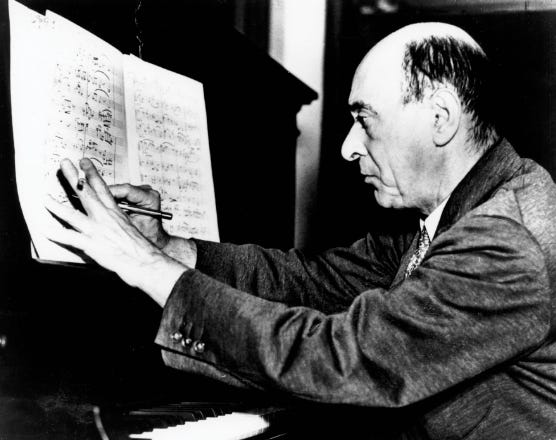
The other central piece is asymmetric phrase lengths. Pop songs, which punk rock largely builds from, runs on four- and eight- bar phrases. Writing five or seven, or clipping to three is called asymmetric phrase lengths or phrase asymmetry. It names what, as a listener, you can feel as it creates the unique motion and flow of the song but you’d need to go count to really locate.
Phrase expansion is when a musical phrase lasts longer than anticipated, usually by delaying its final cadence. It’s similar to phrase asymmetry in that it alters the standard four- and eight- bar phrases and helps create an added sense of depth or emotional tension within the music.
The thing I love about this album though is that Dillinger Four pull off these styles almost without notice. I think it’s possible to listen to the album, love it and sing along, without realizing that you’re doing it to song structures that break from the standard. Perhaps, this speaks to their quality. They can write songs with divergent structures and yet still make them catchy as hell. In part, it’s because they still rely upon a lot of the well established elements. Pick slides when you want pick slides. Ahhs and ohhs where you want ahhs and ohhs. Again, it’s a hybrid. D4 also invokes the older punk (and hip hop) practice of kicking songs off with samples from movies, shows, or elsewhere (see, for instance, two tracks off previous perfect punk album entries, Jawbreaker’s “Condition Oakland” or Spirit Assembly’s “Simple Transaction” or “Ostrichsized” by Lifetime or “Both Guns Blazing” by Bane or countless others). The opening sample, in my view, speaks directly to the way they write their songs: “One additional word of advice: you have to listen closely or you can easily get behind when listening to this record.”
We don’t really see these elements kick off until about halfway through the third song. The first two follow standard pop song structures and sound like standard, albeit very well done, punk songs. To me, it plays like these first two are needed as warm ups (in fact if you want to hear the standard that they diverge from, listen to these first two tracks). Something to get the gears turning, the juices flowing, so that by halfway through the third song (and one of the album’s best) “parishiltonisametaphor” we start to see some of the divergence emerge within the song structures. Which, as I write out their song titles now, I can’t help but think of the similarities between what I’m trying to describe and how they write many of their song titles. Their phrases and words compacted into one giant word, the changes between lowercase to ALL CAPS words. Variation when you wouldn’t expect it.
Take “Gainesville.” It’s one of the more melodic songs on the record, and sounds the most like a straight-ahead pop punk song, but it’s also one where they “cheat” perhaps the most. The whole song is built out of one four-chord phrase. A, E, D, B. You hear it in the first line of the first verse, and it sounds completely ordinary, because A to E to D is about as plain as punk gets. Except that fourth chord. In the key of A, that B is supposed to be a B minor. They play it major. One chord, and the whole phrase tips toward a key that feels fresh. The song is a variation of this phrase over the rest of the song. Three lines later, still in the first verse, it comes back with the B lopped off. Just A, E, D, and you’re waiting for the fourth chord, but it doesn’t show up.
What’s more is that the verse splits into two halves that both land on the same two chords, G and D. Both halves are eight bars and have the same frame twice. But the first half fits three lines of words into it, and the second fits four. Both run the same descent underneath, A down to G# down to G, but the second pass wedges B minor and A in front of it. That insertion is interpolation, and what it does is leave the G# standing on a line of its own. That’s the second chord in the verse that isn’t in the key, after the B. The first time through, it’s tucked in behind an A, and you may barely register it. The second time it’s out in the open.
Then the chorus plays the phrase twice in a row, which is the only place in the entire song where anything repeats itself exactly. The third time through, singing the same words, the chords underneath change. A, F, F# minor, D. The F isn’t in the key either. Same line, same melody, but now with a different floor. This is one of their principal methods on display. One idea, but turned over and over and not allowed to sit still. This is developing variation. Of course, Schoenberg was talking about Brahms, and I am here talking about a punk band from Minneapolis whose lyrics seem like half bar jokes.
But back to “parishiltoisametaphor,” which has a ton of moving parts. As I mentioned, the place where you feel it turn is in the second interlude. The first interlude is just the intro figure, C# minor to A to E, played twice. The second one, however, goes to a different cell. A, C# minor, A, F# minor, which is played three times until it’s altered the fourth time around. In this song, the band goes back and rewrites its own filler section, which most bands don’t bother to do. There is variation in the verses as well. The progression has an A major 7th with the 7th underneath it (the A/G# chord), largely felt with the bass stepping down, and goes all the way down to F#. This is close to a jazz voicing embedded within a punk song, and is a similar descending gesture as in “Gainesville.” The outro bridge then takes on an asymmetric phrasing, mostly bouncing between A-E-A, but then introducing a D chord until the end when a F# drops in.
At the other end of the spectrum, they make their plainest song structure interesting through the drums. The chord progression in “MINIMUM WAGE IS a GATEWAY DRUG” is D, A, B minor, G. This is the prototypical, four-chord progression underneath songs like “Let It Be” or “Don’t Stop Believin’.” In other words, it’s ordinary. D4 plays it twice through the verse without any substitution or something outside the key on the guitars. What changes, though, are the drums. Halfway through the verse, on the second time of those four chords, the drums double up. The snare hits on every beat instead of every other. (D4 has their own internal language, usually creating onomatopoeia, for songwriting elements. They call this the “taco” beat as a rhythmic mnemonic for the way the drums end up sounding.) The tempo hasn’t changed, but it makes the song feel like it’s running twice as fast. Even though it’s the same basic chord progression, it doesn’t sound the same anymore. They do a similar technique on drums in “AMERICASPREMIEREFWITHBASEDINITIATIVE.”
In a 2019 interview marking their 25th anniversary as a band, guitarist and vocalist Erik Funk discussed this method directly. “Normally, the way D4 thinks is,” he says, “Well, if you have something that’s too catchy, you have to mix in a really atonal part. You have to sabotage that song somehow.”
“Fruity Pebbles” is another great example. It’s in the key of G. The first time through the verse, it rides G for several measures, until it bounces up to D and drops down to C. This is V to IV, moving backward. The chorus ten opens on E major. This is some of the sabotage Funk mentioned, since in G the chord on that degree should be E minor. E major introduces G# in a song that has no G# anywhere in its scale. This is the same kind of swap as the B in “Gainesville.” They take the diatonic minor chord and play it major instead. After the chorus is the bridge, featuring seven chords played straight through: B flat, A, G, B flat, A, C, D. This is the same three-chord cell done twice, but the second time it climbs instead of continuing down. This change anticipates the atonal return that happens the second time around in the verse, where, after the drop from D to C, you get a short, and beautiful step down of Bb to A before resolving back in the G. Man, I love that. The bridge got into both of them, so the material spread rather than simply regurgitating.
But stepping out of the music theory for a moment, I just want to say this is such a fun record. The melodies, both vocals and guitars, the rhythms on drums and guitars, the tempo changes, and the sing-along vocals. It’s damn catchy. Even when the lyrics deal with hurt, the songs juxtapose upbeat and poppy instrumentals. If I want an album that will get me in a good mood, head nodding, and foot tapping along, it’s this one. I think there’s a reason the opening sample on the first track ends by saying, “We’ll soon have you disco dancing with the best.” My one main critique? They most certainly should’ve ended the album with “Like Eye Contact In an Elevator.” It’s a perfect album closer. Emphatic. Unrelenting. I can imagine the band and audience alike exhausted, spent, at the end. But maybe this is just more sabotage, as instead they close with “down Cars On Cinder Blocks,” which ends on an unresolved chord progression. It feels like an ellipsis. Shouldn’t something come next? Well, for me, the only answer is to do what that initial sample says, “go back to the beginning of the cut and start over,” and start the album again.
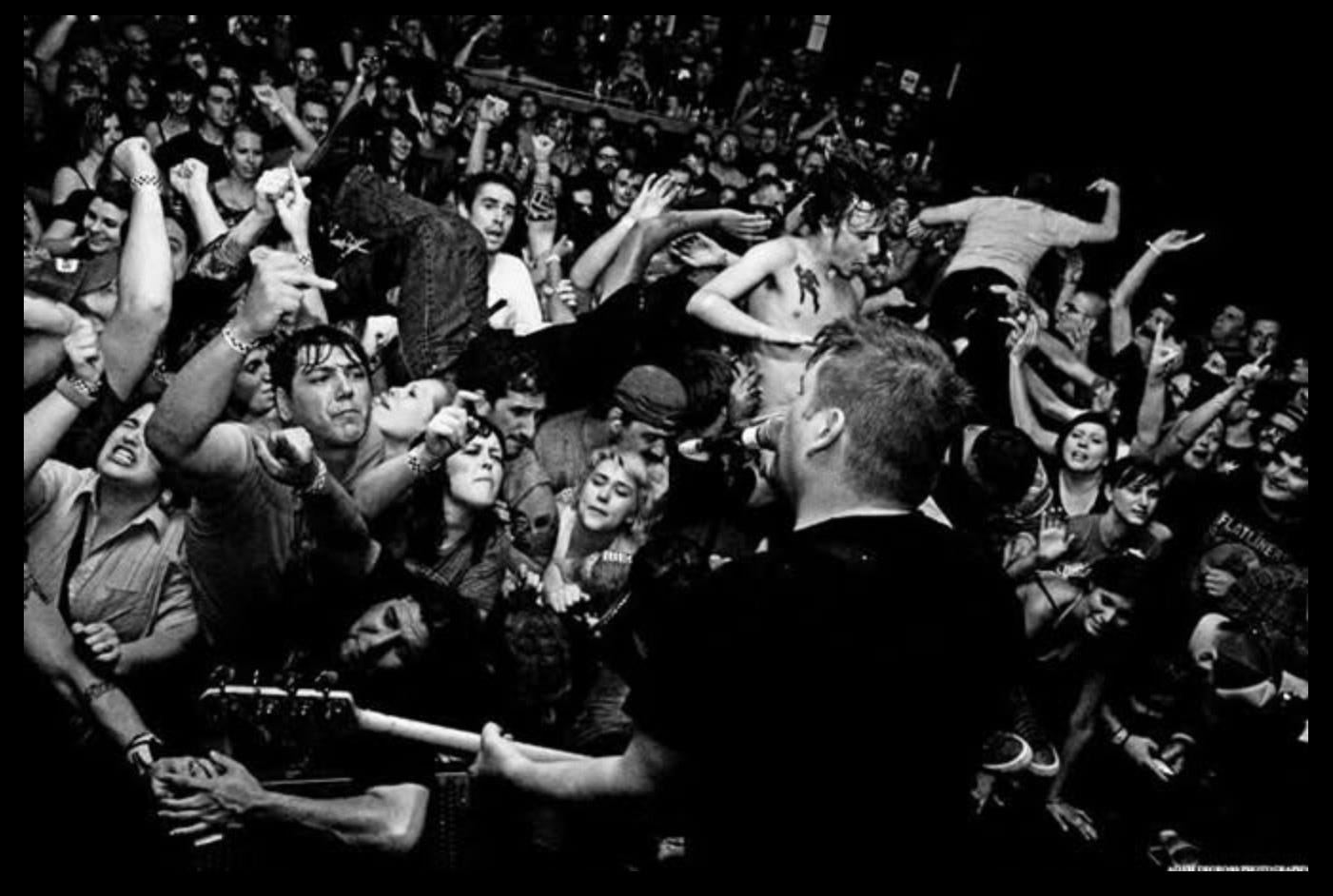
Thank you again for coming along for this ride.
Let me know what you think!
Share with a friend!
Stay in touch!
You can also catch up with all the posts by visiting my handy dandy guidepost to all my pieces, perfect punk albums and more, so far:
A Guidepost to “For Want Of…”
As this blog continues to expand, and with a few different threads or series unspooling, I thought it’d be helpful to have a landing page to help find your bearings, whether it’s your first visit, repeat, or you’re me and just trying to keep it all organized in my head.