
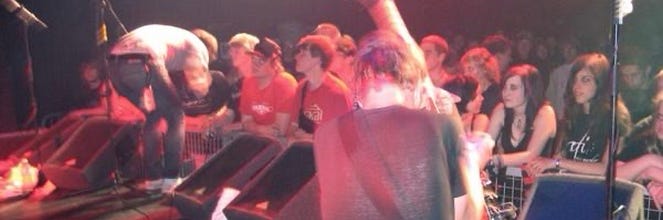
What is it that makes a scene larger than just a scene? What makes a time and place have an enduring impact? Why do I keep talking about punk from the 1990s?
I started writing this post while drafting my “perfect punk album” post #8 about Social Distortion’s Sex, Love & Rock ‘n’ Roll, and I realized that, eight entries into that series, it was my first album outside the 1990s. After three paragraphs or so of exploring why that could be, I realized I should just peel it out, work on it a bit, and keep it for its own post. So here it is.
But the thing I’m exploring here started well before I started drafting that post. It’s a question that has been posed to Courtney, Allen, and me multiple times by everyone, friends, family, fans, interviewers, since Eldritch Anisette agreed to work with Numero Group to reissue our material, which was recorded in 1996 and originally released in 1997. “What is it about this time period, this music, the ‘90s, that explains this renaissance of sorts?” My own question explored here is maybe a bit more introspective, self-centered, and simpler than that: why are my perfect punk album selections thus far (oh, and certainly the ones to come) dominated by releases from that decade? Am I being lazy? Is it selection bias? Or is it something else, something more?
My first six entries included releases from Spirit Assembly, Sunny Day Real Estate, Lungfish, Superchunk, Jawbreaker, and His Hero Is Gone. I made a post about five honorable mentions, albums I really wanted to pass the test, but just fell short by a track or two. Again, the ‘90s. Seaweed, Mineral, Team Dresch, Avail, Neurosis. Eleven albums, all from the same decade. And they feel like just the tip of the iceberg of albums left to consider and explore. Most of the ones people encourage me to consider also fall within these years.
It may very well be that I’ve been focusing there because of my own generational bias. If you’ve been following along by now, you know that I came of age in punk rock starting around 1993, at 13, and was fully submerged by the next year. That said, I remained actively playing in bands and setting up shows all the way through 2012 (and started back up this year). Don’t those 12+ years of being involved in music outside of the ‘90s mean anything? Wouldn’t I have bias there? Wouldn’t that water down this anchoring in the ‘90s that is emerging? But still, maybe it’s reverence to those early years and initial albums that one heard and listened to on repeat: the times, places, people, memories associated with it, the freshness of the sound, the excitement of early personal discoveries, the simple association of coming of age and figuring yourself out while establishing a soundtrack that goes with it. There’s a lot to be said about the affinities we have for a record that changed things for us. Could be. After all, I can’t seem to escape a perfect punk album entry without attaching some of my own personal experience and memoir to it.
Like generational or selection bias, it could also be survivorship bias. The ‘90s had thousands of forgettable records, and we only remember, or I only write about, the good ones. The perfect ones, in fact. I think every decade faces this, though, and this one offers an unusually strong crop of perfect albums.
But I’m going with the simpler and perhaps more provocative proposition that the ‘90s simply churned out incredible punk albums and held the right enabling conditions for cultural production through DIY punk music that stands in its own spotlight. The scene was still incredibly vibrant and emerging. Subgenres and aesthetics were still being refined, if not outright created. Pop punk, hardcore, hardcore punk, melodic hardcore, post-hardcore, crust punk, emo, power violence, screamo, skramz, and more that I forget, forgot, never knew was a label, or still don’t understand what it is. Fugazi’s Repeater kicked it off in 1990. Fugazi was still playing! Refused’s The Shape of Punk to Come was released in 1998. There was so much innovation and creation packed within a dense cluster of years. Maybe that’s because there was solid footing to stand on - that classic ‘70s punk, the launch of hardcore in the ‘80s, and the initial waves of subgenres, most notably emo. I don’t intend to dismiss or disparage the music that came before. And there will be albums from those years. But what I’m saying is that they already existed and gave the 1990s a footing to stand on, without sinking you into it. Solid footing with room for roots, but also to grow and diverge. What I’m saying is that it hadn’t fully developed or saturated. Now, I don’t mean any disrespect to the 2000s onward. It’s not that the 2000s-on are without experimentation and evolution, but for the ‘90s, while there was a musical lineage to draw from, there wasn’t too much that it’d act as quicksand to pull you under, or clouds to cover you up from the light. To some degree, it makes it harder to stand out on your own when the referentials may drag you under rather than lift you up.
While major labels had been consuming earlier punk from bands like The Ramones and The Clash, the ‘90s also marked the period when they launched a buying spree. Nirvana helped kick a door in, and then Green Day blew it off its hinges. Others were signed in hopes they’d be the next big thing - Jawbox, Jawbreaker, Samiam, Bad Religion, Shudder to Think, Jimmy Eat World. With majors breathing down the scene’s neck, it also drew sharper lines (for better or for worse, sometimes) as to what the music was, and how it should continue to evolve. And some bands that were offered refused it. Fugazi, Superchunk, Rancid. HearttaCk refused to review any record with a barcode (remember that?).
There was also a battle within the scene for who belonged and whose voice would be heard. I don’t mean to say that this had to be necessary or was even worth it, but I think that the fight over who belonged also produced some of the best bands and records, whether they be Los Crudos, Dahlia Seed, Team Dresch, or others. The determination, the passion, and, of course, the talent simply shine through.
But there’s lots more to it, too.
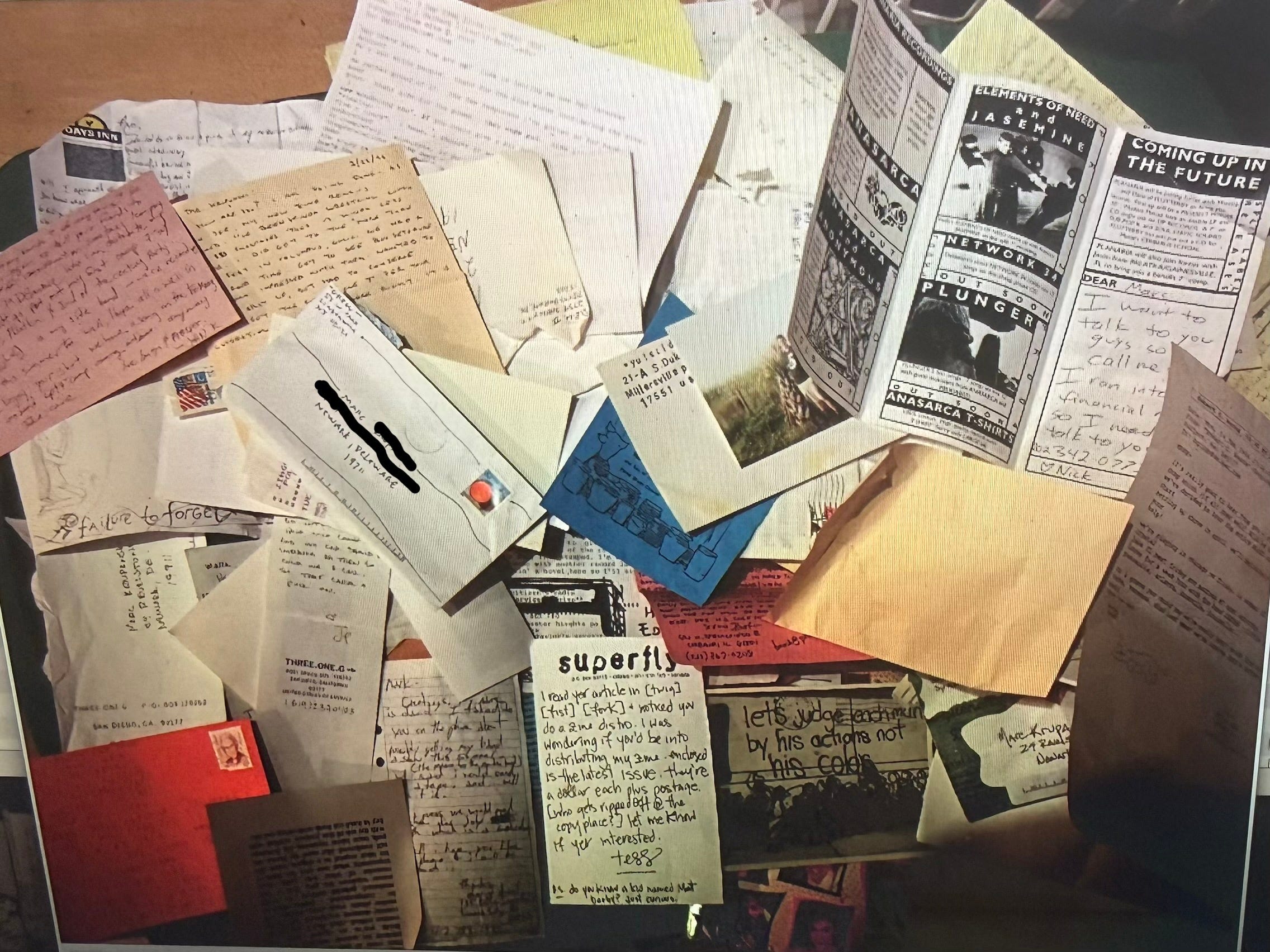
There was a thriving ecosystem of independent labels, clubs, zines, and more. The DIY ecosystem was at full force. You could set up shows for your favorite bands. You could see your favorite bands play on the floor of your local VFW hall or church. You could set the shows up. Did you like a band? You simply wrote them and said, “Hey, I can give you gas money, food, and a place to sleep,” and chances were they’d say yes. I have some receipts to show for it, too. And if not you, there was still a rich selection of independent music venues in most towns, including ones willing to cater to underground bands and all-ages shows. And bands would often be booking these shows themselves, with little mediation from agents. There was even a regularly updated zine to help you do this, Book Your Own Fuckin’ Life.
Does that create better albums? I think it does. It both leads to and is representative of a thriving and healthy cultural ecosystem. It allows access, experimentation, a ready feedback loop, and exchange. It’s an enabling environment. Maybe it’s similar to when people talk about certain periods of dense cultural production: the 1920s Parisian jazz age, the 1920s Harlem Renaissance, the 1940s bebop scene in New York, the early 1960s Greenwich Village folk scene (okay, I may have a New York bias, too). You have, in each of these, a dense environment of deep dedication to the art and the craft. A heightened accessibility for creators and audiences, and where there wasn’t one, people just created it themselves. The exchange and constant iteration-reiteration, the give-take, borrow-steal. Even though gatekeeping and snobbery existed, there was a sense that the more the better.
Now, of course, one unique aspect of the period I’m talking about, compared with Harlem or Paris in the ‘20s, is its geographic expanse. Harlem and Paris worked because you could walk across a neighborhood, sit in the same cafe, and walk down the street to the other loft space or club. But here, it’s not just concentrated in a city or a neighborhood within a city. It was U.S.-wide. Yes, it was anchored in local nodes that allowed refinement and, if you will, cultural hubs to emerge. San Diego, D.C., Chicago, Delaware, Louisville, the Bay Area, Richmond, Syracuse, Columbus, Little Rock, Gainesville. But the ‘scene’ was bigger than any one place. True, one could even make a case that it extended beyond the U.S. I haven’t even gotten into the bands and connections outside the US, whether Shotmaker or Propagandhi from Canada, Jasmine from France, Refused from Sweden, Seein’ Red from Holland, Acme from Germany, Bob Tilton from England. But here and now I’m talking about the U.S., but I do mean the entire continental U.S. How could such a cultural milieu be so dense and yet so geographically expansive? But if you’ve been reading my posts up until this point you’ll know what I’m about to say: we created not just “a scene,” but a community, a network, often problematic and not without its issues (oh trust me, there were plenty), but a self-directed, independent, underground network of punk cultural creators, audiences, curators, participants. The network served the neighborhood’s function. I talked about the DIY punk pen pal network in my perfect punk album post on His Hero Is Gone’s Monuments to Thieves. People you’d meet at shows, you’d stay in touch with. If you really liked a zine, chances are you’d write the creator, and they’d write back. Same with bands and labels. There was accessibility, but even more than that, there was connection. Connection was the point. Just like I discussed in my post on the first expo of the Delaware Music History Archive, participation and creation weren’t just from the bands, and the net result of all of that was something like community. And maybe, perhaps, the slow form it took, the intentionality it took: letters, phone calls, road trips, taking a limited number of photos and waiting for them to develop, built that connection in a way that a click and a like have trouble replicating.
Which brings me to an obvious argument: it was also before digitization took hold of everything. Yes, computer advancements from the internet to home recording technology may be the “great democratizer,” but they also opened the floodgates of overproduced music, autotune, and the unraveling of print media. Yes, the ability to self-release records is great, but it was also met with the thinning of independent labels, the greater absorption of punk into corporate media and consumption, Ticketmaster now sells basically every ticket, and the wider release of slop. While home recording and self-releasing became easier, they took a different form within DIY culture. While ‘90s bands would often record with friends or put out records themselves, they still relied upon a network and a community. A click and post alone can create output, but risks doing so without community. And of course, punk became much more mainstream. Metrics shifted. It was more about numbers, consumption. Even though the ‘90s lived off 7”s, I think that less had to do with writing a single but more about the desire to record quickly and their accessibility. Streaming, as we all know, moved things away from albums, and heck, maybe even considered EPs, and more toward singles. And the algorithms make and remake that. The music and the environment in which it was created changed.
But maybe that’s all bullshit. I don’t know.
As I said at the top, I’m now often asked why I think there’s such a resurgence of interest in the ‘90s punk scene from people in their early 20s and late teens, specifically the mid-‘90s emo scene my band, Eldritch Anisette, and many others were part of. I don’t know why exactly. I’m still trying to figure it out. It may be as simple as the 30-year cycle phenomenon, the so-called “nostalgia pendulum,” where cultural trends reemerge for the next generation. That’s probably some of it, but I do think it’s something more. I think it’s a combination of having a thriving DIY community and being on the cusp of the internet age. Before the flood of accessibility and algorithms. Where music creation and discovery were a personal journey, and frankly, an effort, in a way, the internet and social media lessen. There was intentionality. On the production end, it was less about pushing content than it was about refining craft. When everything is spoon-fed, I think it’s more alluring to find gems that weren’t fully pushed by an algorithm and, more so, an environment that was tactile. Things were produced with the intention of being held physically. But it is a strange irony. The internet is the reason much of the mid-‘90s music has stayed alive and become discoverable. I mean, heck, I’m on here writing about it all. But I think it’s also a reason why it’s resonated. It’s evidence that another way of expression and connection is possible. That we did all this without any of this. But also, of course, I think it’s just really good music.